Everybody talks about the fear of missing out (FOMO) and how it affects funded traders and participants in funded trading programs like Earn2Trade’s Trader Career Path® and The Gauntlet Mini™. However, equally, if not more dangerous, is its opposite, FOBI – the fear of being involved (also referred to as “the fear of being in” or “the fear of being included”).
This guide will take a deep dive into FOBI, exploring what it is, how it affects funded traders, and how it differs from FOMO. Importantly, it will uncover strategies to overcome the psychological bias to make you better prepared to preserve and grow your account. So, let’s cut to the chase, shall we?
What Is the Fear of Being Involved (FOBI)
Imagine the following situation: you’ve done the analysis, and you’ve got a clean setup and a well-established level. Considering that that’s exactly what your playbook calls for, there’s no reason not to jump in, right?
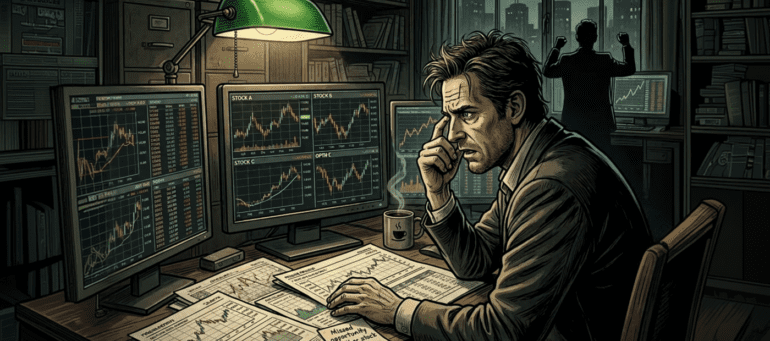
Except that, when you try, you start hovering your cursor over the buy or sell button… and hesitation sets in. Maybe you wait for “just a bit more confirmation.” Maybe you tell yourself you’ll catch the next one. And then price moves – perfectly, but without you.
At first, it doesn’t feel like a big deal, and you tell yourself there will be more opportunities. Markets are always there, right? But as the day unfolds, you start noticing a pattern. The clean setups that you should be taking keep passing you by. Meanwhile, the only trades you actually execute are the ones you feel slightly uncertain about. Ironically, those are often the ones that don’t work.
Enter the fear of being involved (FOBI), a psychological bias that makes you stop, stare, and avoid participation. The thing about FOBI is that it isn’t just fear of entering a trade but a feeling much deeper than hesitation. Think of it as the discomfort of exposure.
Unlike FOMO, which pushes you into impulsive action, FOBI creates a kind of quiet paralysis. You’re engaged, you’re watching, you’re analyzing, but you’re not participating. You basically become a spectator in a game you’re supposed to be playing.
With FOBI, the psychological damage begins not from losses but from regret. And regret compounds differently than drawdowns.
The core idea that fuels FOBI’s long-term devastating impact is that, while a losing trade has closure, a missed winning trade lingers, and you will be replaying it in your head, often for the foreseeable future. Then you might start second-guessing your process. Ultimately, your confidence will erode – slowly but surely.
In funded trading, success isn’t just about avoiding mistakes but about capitalizing on opportunities. In that sense, if you’re consistently present but inactive, you’re not managing risk but avoiding growth.
In trading psychology terms, FOBI connects directly to loss aversion, which is the tendency to prioritize avoiding losses over acquiring gains. But in funded trading, this bias is amplified by external pressure, since you’re operating within rules, expectations, and evaluation structures. As a result, every decision feels more consequential, so your brain adapts by minimizing exposure altogether.
How FOBI Works
FOBI thrives on the logic that, when you’re in a trade, you’re vulnerable – your PnL fluctuates, your decisions are tested in real time, and it might feel like your identity as a trader is on the line.
Our brains, wired for survival, don’t like that uncertainty, so they can welcome FOBI with open arms, trying to protect you by keeping you out.
What makes FOBI particularly dangerous is that it often disguises itself as intelligence. It doesn’t feel like fear but like control. You tell yourself you’re being selective, waiting for a higher probability, avoiding unnecessary risk. And sometimes, that’s true. But over time, that selectivity becomes excessive.
You start filtering out trades not because they don’t meet your criteria but because they make you uncomfortable, although the bias makes you think that it is the former that makes you stay on the sidelines.
However, the thing is that trading isn’t about avoiding risk but about managing it. Since FOBI makes you replace management with avoidance, over time, it creates a disconnect between your strategy and your execution. And even if you might have a solid system on paper, in practice, you end up trading a completely different strategy – one dictated by comfort rather than logic.

FOBI vs FOMO: Two Sides of the Same Psychological Coin
Most traders are familiar with FOMO, a loud, impulsive, and easy-to-recognize psychological bias. On the other side is FOBI – its quiet, rationalized, and often disguised as caution, cousin. Here’s how they differ from each other:
| Trait | FOMO (Fear of Missing Out) | FOBI (Fear of Being In) |
| Core Emotion | Greed + urgency | Fear + avoidance |
| Behavior | Chasing trades – even those that don’t fit your criteria | Skipping trades and staying on the sidelines even when “the perfect” setup emerges |
| Entry Timing | Too early | Too late (or none at all) |
| Risk Profile | Overexposed | Underexposed |
| Outcome | Large losses | Missed gains |
| Psychological Narrative | “I need to be in this move.” | “What if I’m wrong?” |
What’s important to understand is that most traders don’t sit firmly on one side. They often oscillate between team “FOMO” and team “FOBI.”
For example, it is common to experience FOBI after a losing streak as you become more hesitant, cautious, or overly selective. Then, after missing a few good trades, that hesitation can quickly flip into FOMO, where you start suddenly chasing moves you would normally avoid just to compensate.
The bottom line often is a destructive cycle that goes like this:
- Fear triggers inactivity (FOBI)
- Regret triggers impulsivity (FOMO)
- Losses lead to more fear
And around it goes.
In funded trading, this cycle is even more dangerous because it disrupts consistency. One day, you’re not trading at all. Next, you’re overtrading. From a risk manager’s perspective, this kind of behavior is unpredictable, and unpredictability is the enemy of long-term performance.
Here, the goal isn’t to eliminate emotion entirely, as that’s unrealistic. Instead, the goal is to stabilize behavior regardless of emotion and enable you to execute your plan, no matter whether you feel confident or hesitant.
Because, at the end of the day, both FOMO and FOBI are emotional distortions of the same underlying issue: discomfort with uncertainty.
Why FOBI Is Especially Dangerous in Funded Trading
If you’re trading your own account, FOBI might simply mean slower progress, with growth more gradual (or often absent) for a certain period of time. But in a funded environment, if it persists, it might become a structural problem. That’s because many funded programs operate on three key constraints:
- Time pressure (this isn’t the case with Earn2Trade’s programs, as there is no fixed maximum timeframe, so you can take it at your own pace)
- Profit targets
- Consistency requirements
FOBI risks disrupting that completely. Imagine you’re in an evaluation phase with a 15-day window and a fixed profit target. Your system statistically requires around 25–30 trades to reach that target with reasonable variance.
Then FOBI enters uninvited, convincing you that no trade is worth it and that the “perfect conditions” are yet to pop up on the chart. You start hesitating and skipping trades as a result. Then, by the end of the evaluation, you’ve only taken 10 trades. Even if your win rate is strong, you simply haven’t participated enough to reach the target.
Many traders will misread this situation, assuming their strategy isn’t good enough. However, in reality, they never gave it enough exposure to prove itself.
There’s also a psychological trap here, since avoiding losses might start to feel like progress. You stay within drawdown limits to avoid big mistakes, but, at the end of the day, the scoreboard won’t reward caution. In an environment like funded trading, it rewards performance. And FOBI, by definition, reduces performance through under-participation.
The “I Can’t Pull the Trigger” Problem
Among funded traders, FOBI often shows up in one specific way: “I can’t pull the trigger.” This phrase reflects a disconnect between intention and action, where you know what to do, but you simply can’t do it. That gap is where most traders struggle.
What’s happening neurologically is relatively straightforward. When you prepare to enter a trade, your brain evaluates risk. If perceived risk exceeds your comfort threshold, it triggers a stress response. That response doesn’t just create anxiety but actively inhibits action.
So even if your logical brain says, “this is a good trade,” your emotional brain says, “this feels dangerous.” And emotion often prevails.
This is why repetition alone doesn’t fix the problem. You can backtest a strategy hundreds of times, but if you haven’t trained your execution under uncertainty, the issue persists.
Another layer to this is memory, as traders who have experienced recent losses often become more hesitant. Even if those losses were part of a normal distribution, the brain can end up anchoring them to pain and try to avoid repeating them.
So the next time a similar setup appears, and hesitation kicks in even if it’s statistically a winning trade, know that this is how FOBI becomes self-reinforcing.
Missed Opportunities as the Hidden Cost of FOBI
Let’s talk about something most traders underestimate: missed opportunity cost. When you skip a trade, nothing happens in your account as there is no loss, nor gain, and retaining the status quo feels safe.
However, over time, it can prove costly since trading isn’t about individual trades but about consistent performance. As a participant in a funded trading program or an already funded trader, your edge should emerge over a large sample size. And when you interfere with that sample, you can distort the outcome.
In reality, the critical thing is that you don’t get to choose which trades win. As a result, if you skip trades selectively, you won’t be filtering risk, although it might seem so. What you will be doing is introducing randomness. And randomness can be devastating for consistency.
There’s also a compounding effect. While missing one trade won’t immediately pose a problem, missing multiple in a row can create significant psychological pressure where you will start feeling “behind.” That pressure can eventually push you into FOMO behavior, leading you to take lower-quality setups just to compensate.
So, in a nutshell, FOBI doesn’t just reduce opportunity – it sets the stage for future mistakes. Over time, this creates what can be called opportunity decay, gradually eroding your trading edge and performance due to inconsistent participation.
Why FOBI Might Feel Rational (But Isn’t)
One of the most dangerous aspects of FOBI is how logical it sounds. It makes your brain convince you that:
- You should wait for confirmation
- The market feels uncertain
- You should protect your capital at all costs
All of these statements are reasonable and, in fact, often encouraged in trading education, including in Earn2Trade’s funded trading programs. However, when they’re used selectively (e.g., when the trader feels uncomfortable), they might pose a problem.
That’s the key distinction. If your strategy requires confirmation, it should be defined clearly and applied consistently. On the other hand, if you only wait for confirmation when you’re hesitant, it’s not part of your system but instead a psychological filter.
Traders usually lose objectivity when decisions become context-dependent and influenced by recent outcomes or emotional state rather than predefined rules. Over time, this repeated cycle results in increased inconsistency in performance, distorting the proper evaluation of your performance. As a result, it becomes difficult to tell whether your strategy works because you’re not executing it properly. In that sense, FOBI not only affects results but also undermines learning.
The Role of Loss Aversion in FOBI
At the core of FOBI is one of the most well-documented cognitive biases in finance: loss aversion. It is the result of humans being wired to avoid pain. In evolutionary terms, this made sense since avoiding danger was critical for survival. But in trading, this instinct becomes counterproductive, as every trade carries risk, and losses are inevitable. However, the brain doesn’t process them as neutral outcomes but rather treats them as threats.
So what it does is make you adapt by minimizing exposure. In funded trading, this effect is amplified by rules (e.g., drawdown limits, evaluation criteria), which create a sense of external judgment. As a result, losing becomes not only a financial outcome, but a question of success or failure.
Understandably, this can increase the emotional intensity, which, in turn, can increase avoidance behavior. The result is a feedback loop where fear leads to inactivity, inactivity leads to frustration, and frustration reinforces fear.
One strategy for breaking this loop is reframing losses not as failures but as necessary components of a probabilistic system. Let’s explore some others.
Practical Strategies to Overcome FOBI
Similar to FOMO, overcoming FOBI can often be quite challenging, and even the pros aren’t always able to eradicate its impact completely. However, the key is to understand how it affects your trading performance and minimize its impact as much as possible. Some of the popular practical strategies for doing so include:
- Systematizing Your Entries: Usually, the more room there is for interpretation, the easier it is for fear to interfere, so define your setups in concrete terms (e.g., exact conditions for entry, exact conditions for invalidation, acceptable variations, etc.) This will help reduce cognitive load, enabling you to execute more confidently rather than being stuck in the constant loop of analysis.
- Use “Minimum Viable Size”: Fear is proportional to perceived risk, meaning that if you reduce the risk, you will also be able to lower the emotional barrier. In practice, this means trading smaller than feels necessary and, instead of prioritizing profit as the sole goal, you aim for consistency. Over time, execution will become automatic, and once it does, you can start gradually increasing position size.
- Track Missed Trades: This is one of the most powerful tools. By documenting missed opportunities, you can make the invisible visible and start seeing patterns in your hesitation (e.g., when it occurs, why it occurs, and how it affects results). Over time, this builds accountability.
- Reframe Losses as Business Expenses: To make it easier to bear and limit the impact of FOBI, think of trading as a business. Every business has costs, and so does trading. These costs come in the form of losses. That is why it is important to think of them not as mistakes but as operational expenses. Accepting this will effectively help you limit the intensity of fear and its impact on your trading performance.
- Build Execution Discipline: We’ve said this many times, but let’s reiterate it once again – strategy without execution is meaningless. That is why you should focus on taking every valid setup, following rules regardless of emotion, and measuring consistency. Doing so repeatedly will turn it into a habit, and habits can be that much-needed barrier that prevents FOBI from bulldozing through your trading routine.
Finding the Balance Between Fear and Action as the Key to Success in Funded Trading
In funded trading programs like Earn2Trade’s Trader Career Path® and The Gauntlet Mini™, traders often assume failure comes from overtrading or poor risk management. While that’s often the case, the truth is that among the top reasons for not passing the evaluation is also falling prey to emotions or psychological biases. FOMO and FOBI and their impacts are shining examples.
At the end of the day, you can study charts, refine strategies, and analyze markets endlessly, but if you don’t execute, none of it matters. In other words, preparation without participation is meaningless.
So, to put it simply, trading is often a balance between fear (inaction) and greed (action). While FOMO pushes you to act impulsively, FOBI pushes you to avoid action entirely. Your goal as a trader is controlled execution. While staying cautious is often an advantage, there is a fine line beyond which it starts painting even the most perfect setups as uncertain, making you miss the very opportunities you need to succeed.
Give the strategies explored above a try in a demo account and let us know if they’ve worked for you in the comments.