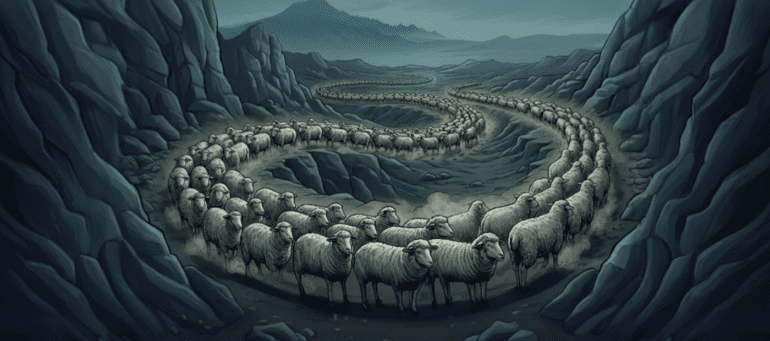
We’ve all been in these situations when the peer pressure has made us do something we weren’t actually convinced of – whether it is going out when not feeling it, buying something that we don’t need, or catching that one-in-a-lifetime trade that everybody talks about. Just imagine: the price starts moving, and someone posts a chart in the trading community, be it a trading room, a Discord server, or your favourite trading subreddit. Then another user follows. Then a third jumps. And just like that, within minutes, what began as a single opinion becomes a shared conviction: “It’s breaking out;” “Everyone’s long;” “This is the move;” “Don’t miss it.”
Hesitation then disappears, and the uncertainty that normally accompanies a trade begins to fade. Instead, something far more comfortable settles – consensus. So, you click buy – not because your system told you to, but because everyone else already did.
This is herd mentality at its finest. And in funded trading, it’s one of the fastest ways to lose both money and control. This guide covers everything you need to know about the herd mentality bias, including what it is, what its origins are, what makes it so dangerous for traders, and, most importantly, the strategies you can explore to protect yourself from it. Let’s dive in.
What Is the Herd Mentality Bias
The herd mentality bias explains the tendency for individuals to mimic the actions and decisions of a larger group. It is rooted in evolutionary survival instincts. For early humans, staying with the group increased survival chances (e.g., “If the entire tribe runs, I should run too”), while independent decision-making was perceived as riskier.
In trading, it explains collective behavior, such as market bubbles (e.g., dot-com crash) and social panics, where fear of missing out (FOMO) overrides individual logic. Herd mentality prompts individuals to skip independent analysis and avoid seeking a clear rationale. Instead of making decisions based on a structured trading plan, traders defer to collective behavior, assuming that the group must “know something” or even “must know better.”
While herd behavior might have conferred benefits in evolutionary terms, in financial markets, the instinct becomes counterproductive. Behavioral finance experts have shown that humans consistently rely on heuristics and mental shortcuts when making decisions under uncertainty, and one of these is social proof – if many people believe something, it must be true.
Markets amplify this effect because uncertainty is constant since there is no “correct” answer in trading, and all you have are probabilities. That ambiguity creates discomfort. Since the brain seeks relief, the easiest way is to align with others.
Historically, herd behavior has been at the center of some of the biggest market events – from the dot-com bubble to the 2008 financial crisis. In each case, participation increased not because fundamentals improved, but because more people joined the trend.
For funded traders, understanding this origin explains why the urge to follow others isn’t a personal flaw but a built-in response, and why the main goal isn’t to eliminate it, but to recognize when it’s influencing your decisions and act accordingly.
The Origins of the Herd Mentality Bias
The concept evolved from 19th- and early 20th-century studies of crowd psychology and sociology, with various people contributing to it. For example, it can be argued that Charles Mackay, a Scottish poet, journalist, author, anthologist, novelist, and songwriter, first identified the early facets of the behavior in his 1841 work, “Extraordinary Popular Delusions and the Madness of Crowds,” where he looked at market bubbles as a byproduct of collective obsessions (e.g., the South Sea bubble).
The French social psychologist, Gustave Le Bon, then laid the groundwork with his 1895 book, “The Crowd: A Study of the Popular Mind,” which examined how individuals in a crowd adopt a “group mind.” Wilfred Trotter followed and popularized the phrase “herd behavior” in his 1914 book, “Instincts of the Herd in Peace and War.” Other key historical contributors include Sigmund Freud, who explored “group psychology” and the “herd instinct” in his 1921 work, “Group Psychology and the Analysis of the Ego,” and Friedrich Nietzsche, who discussed “the crowd” and “herd morality/instinct” in many of his philosophical works.
In modern times, the herd mentality and its impact on financial markets are frequently studied by behavioral finance experts and Nobel laureates such as Daniel Kahneman and Robert Shiller.
Why the Crowd Can Feel So Convincing
Humans aren’t wired to operate independently under uncertainty, and, in most areas of life, following the group feels efficient and safe – if everyone runs in the same direction, there’s probably a reason.
However, in markets, that instinct becomes a liability since markets aren’t built on consensus but on disagreement. For every buyer, there’s a seller, and for every conviction, there’s an opposing view. So, the moment “everyone agrees” is often the moment the move is already crowded. Latecomers, often retail traders, are then basically reacting to a move that has already occurred, and crowded trades can often unwind violently.
This is why herd mentality feels so convincing at exactly the wrong time. By the time an idea becomes popular, it’s usually too late and “the easy money” has already been made.
Still, the psychological pull remains strong, with multiple studies finding that traders exposed to group opinions were significantly more likely to override their own analysis, even when their initial assessment proved correct. In other words, the presence of consensus can often distort decisions.
There’s also a neurological component at play. Social agreement is believed to activate reward centers in the brain. When others confirm your view, it reduces perceived risk, even as actual risk increases, creating a dangerous illusion of safety.
The Rise of Social Media as a Fuel for the Dangerous Moment When Information Becomes Noise
Herd mentality has become more prominent and widespread in recent years, with the rise of social media. For example, twenty years ago, traders operated in relative isolation, while today, they’re plugged into a constant stream of opinions, charts, and real-time reactions. On the surface, this might seem like an advantage, since more information should lead to better decisions, right? But not quite.
The truth is that most of what flows through trading communities isn’t information but interpretation, shaped by bias, emotion, and positioning. So, when you scroll through a feed and see ten traders posting the same bullish setup, it doesn’t mean the setup is strong, but that the particular idea is popular.
What’s more, social platforms reward visibility and not accuracy. The most confident, loud, or visually appealing ideas get the most attention, while the most accurate ones often remain buried in the noise. This creates an environment where narratives spread faster than analysis.
Herd Mentality vs FOMO: What’s the Difference?
Herd mentality and FOMO have much in common and are often mistaken for each other. However, they’re not the same, and confusing them can make it harder to manage your behavior.
FOMO, or Fear of Missing Out (learn all about it in our dedicated guide), is the feeling that you’re about to miss an opportunity and is driven by urgency. Price is moving, momentum is building, and you feel pressure to act quickly. The decision is emotional, often impulsive, and focused on the move itself.
Herd mentality, on the other hand, is driven by validation. It’s less about missing the move and more about aligning with others. You don’t just see the price moving, but also that people agree on the direction, boosting your confidence, even if your own analysis is unclear.
In practice, the two often overlap. For example, you might feel FOMO when the price breaks out. Then, as you check social media or chatrooms and see others confirming the move, that FOMO evolves into herd behavior, and what started as urgency quickly becomes justification.
However, it is important to distinguish between them so you know what you are up against and can ensure these psychological traps don’t affect your trading performance. Here are a few key differentiating characteristics:
| Bias | Core Driver | Typical Thought |
| FOMO | Urgency | “I’m going to miss this move.” |
| Herd Mentality | Validation | “Everyone else is in, so it must be right.” |
For funded traders, this distinction matters because the solutions differ.
FOMO is managed by slowing down and taking a breather by adding rules, waiting for confirmation, reducing impulsivity, and learning to control emotions. Herd mentality is managed by increasing independence through mechanisms such as limiting external input, trusting your own judgment, and making decisions before exposure to others’ opinions.
It is also worth noting that while both FOMO and herd mentality can lead to poor entries, the latter is often more subtle and, at times, even more devastating. The reason is that it doesn’t feel reckless but validated by others. And it is in our nature to sometimes put more weight on the opinion of others and start doubting ours, even when it is backed by solid empirical evidence or has been proven right before.
How Herd Mentality Shows Up in Futures Trading
In futures markets, herd behavior tends to cluster around specific moments, such as breakouts above key levels, news-driven spikes, high-impact economic releases, or strong trending days.
These are environments where price is already moving, and visibility is high, with everyone watching the same levels and reacting to the same catalysts. That’s also usually the moment when the crowd forms and when risk increases.
Here is an example – let’s consider the common scenario of crude oil breaking above a major resistance level after a geopolitical headline. Social feeds light up immediately, and traders call for continuation, with momentum steadily building. Following the herd, you hit “buy,” but what is most likely happening is that you are entering a trade where:
- Early participants are already in profit
- Late participants are chasing
- Liquidity providers are preparing to fade
The trade might still work, but the odds are no longer in your favor. So, what most beginner traders often overlook is how these setups evolve.
In futures trading, where execution timing is critical, entering a trade even a few minutes late can completely change its risk profile, turning what looked like a high-probability breakout into a low-probability chase. That’s the hidden cost of herd mentality – it doesn’t just affect what you trade but when you trade. And timing, more than anything else, is what separates disciplined traders from reactive ones.
It is worth remembering that initial momentum attracts attention, and attention usually draws increased participation. It then leads to overcrowding, followed by instability. And this is why many breakout trades can fail – while the level might have been right, too many traders entered too late.
For funded traders, being able to recognize this lifecycle is critical as it helps differentiate between early opportunities and late participation. That distinction alone can significantly improve your trade selection.
Why Herd Mentality Is More Dangerous in Funded Accounts
The idea of social agreement (e.g., others confirming your view) can create an illusion of safety. In funded trading, this illusion is amplified by pressure. When you’re trying to hit targets or recover from a drawdown, certainty becomes psychologically valuable, and the crowd offers that certainty, although artificially.
However, the irony is that the more certain a trade feels because of consensus, the more cautious you should be. Because markets don’t move based on how many people agree. Instead, they move based on positioning, and when positioning becomes one-sided, the market becomes vulnerable.
What makes this dynamic particularly dangerous is how subtle it is. No one explicitly tells you to follow the crowd. There’s no moment where you consciously decide to abandon your strategy. Instead, the shift happens gradually – first, you start by observing, then you start agreeing, and, before you know it, almost without noticing, you start acting.
Following your act, you start justifying by telling yourself the setup aligns with your plan, even if it doesn’t fully. You convince yourself that multiple traders seeing the same thing must mean it’s valid.
The timing distortion discussed in the section above (e.g., by the time an idea is widely shared, early participants are already positioned) also works against funded traders as it creates a structural disadvantage where one is entering trades at worse prices while taking the same risk. Over time, this erodes the trading performance not because the employed strategy has drawbacks, but because its execution is influenced by external noise.
Another reason why participants in funded trading programs are more vulnerable to herd mentality is that it thrives in high-volatility environments and market conditions where slippage increases, spreads widen, and price moves become less predictable. The rules of the programs (e.g., tight drawdown limits, strict risk parameters, performance-based evaluation, limited room for error, etc.) are designed to make you a better-performing and more disciplined trader and can offer some protection against the herd mentality bias.
While a single poorly timed trade might not break your account, a series of consecutive ones, especially in volatile conditions, can quickly push you toward drawdown limits. So, ultimately, it is up to you to identify the moment when you start to lean on others’ non-data-backed opinions rather than your strategy, and to remind yourself that acting on it might put you in breach of your program’s requirements.
There’s also a behavioral inconsistency. Herd-driven decisions are not systematic but vary depending on what you see, who you follow, and how you feel in the moment.
Tips on Addressing the Psychological Triggers Behind Herd Mentality
Herd mentality is psychological, and the main strategy to counteract it is to build confidence in your setup and not trust others (except when you have sufficient data and conviction that they might be right). So, simply put, avoiding herd mentality doesn’t necessarily mean ignoring others, but instead means learning to control when and how you engage with external input.
Several practical tips can help you on that front. For example, you can start by defining your setups clearly – if a trade doesn’t meet your criteria, it doesn’t matter how many people are talking about it.
Delay is another powerful tool. If a setup is widely discussed, wait and let the initial move play out. In many cases, better entries appear after the crowd has acted.
Limiting exposure to the social media buzz and external noise is equally important. Constantly consuming opinions during trading hours is a powerful distraction, so make sure to structure your day so that your analysis comes before exposure to noise.
Finally, track your behavior and journal it regularly (here are useful tips on how to do it properly). That way, you will be able to notice promptly if you start losing focus. For example, if you identify a pattern of entering trades after seeing them online, that’s a signal that you aren’t trusting your process.
Tools to Help Identify Crowded Trades
One practical and often overlooked instrument for addressing the negative impacts of herd mentality is knowing when a trade is crowded and the opportunity people are talking about might be on its way out.
Below are a couple of indicators and objective approaches that can help you spot when a trade is becoming crowded:
| Indicator | What It Signals |
| COT Report (Commitments of Traders) | The positioning of large vs small traders |
| Volume Spikes | Increased participation, often late-stage |
| Open Interest | Rising OI with price can be a potential signal of crowded positioning |
| Funding Rates (in some markets) | Increased sentiment imbalance |
| Sentiment Indicators | Bullish/bearish extremes |
| Volatility Index (VIX) | Fear/greed extremes |
Think of these indicators as context tools, not signals.
Here is an example of how these indicators can align in practice to signal whether a particular trade is crowded: if the price is breaking out while volume surges and sentiment becomes overwhelmingly bullish, it may indicate the trade is crowded. This won’t necessarily mean you should automatically fade it, but it does mean you should be cautious.
Final Thoughts: Following Has Costs, Thinking Creates Value
Let’s be honest, everyone who has ever traded knows that independence is uncomfortable, and it is always easier to lean on others, believing they are better prepared to earn you profits and take you where you want to be long-term.
However, there is value in independence – it means taking trades others aren’t taking, skipping trades everyone else is in, and trusting your process when there’s no external validation. At the end of the day, all of these will help make you a better trader, because that discomfort is where your strategy’s edge lives.
While herd mentality offers comfort, it does so at the cost of timing, discipline, and consistency. And in funded trading, those aren’t optional.
So, if there is one thing to take from this article, let it be this – success isn’t about being part of the crowd, but about understanding it and choosing when to step aside. Earn2Trade’s Trader Career Path® and The Gauntlet Mini™ offer the perfect environment to build confidence in yourself and ignore the noise that you will need to succeed in the long term.