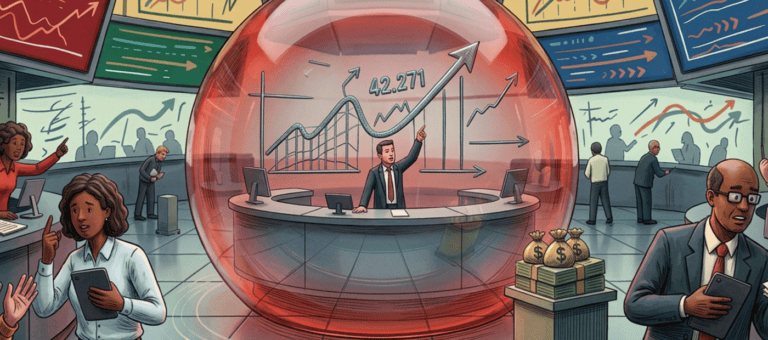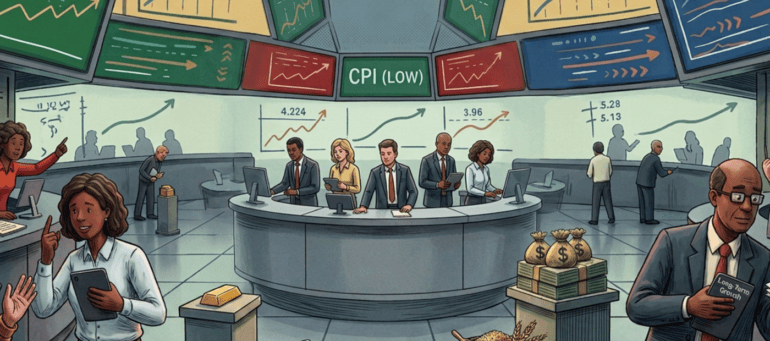
Low inflation is rarely in the spotlight – it doesn’t dominate financial news, produce emergency policy meetings, or cause overnight commodity spikes. There are no television anchors breathlessly dissecting how consumer prices increased by 1.9% instead of 2.1% because stable inflation simply isn’t exciting. This has led many traders to underestimate one of the most profitable market environments in modern financial history.
However, the truth is that some of the strongest and longest-lasting trends across equities, bonds, and several futures markets have unfolded precisely when inflation remained subdued. The decade following the Global Financial Crisis is perhaps the clearest illustration: between 2010 and early 2020, inflation in the United States averaged roughly 1.8%, while interest rates remained historically low for much of the period. During those same years, the S&P 500 delivered annualized returns exceeding 13%, the Nasdaq 100 rose by over 400%, and corporate earnings steadily recovered. Those gains weren’t driven by panic or economic chaos but emerged from an environment of stability, abundant liquidity, and growing investor confidence.
Understanding how low inflation changes market behavior is an important practical framework for deciding which contracts deserve attention, how expectations should be adjusted, and why some trading strategies suddenly begin outperforming while others are left behind. For participants in funded trader programs such as Earn2Trade’s Trader Career Path® and The Gauntlet Mini™, mastering these conditions can become a significant competitive advantage. And this article tells exactly why and how.
The Specifics of Low-Inflation Market Periods and How They Differ From the High-Inflation Ones
One of the most common misconceptions is viewing low inflation merely as the opposite of high inflation. In reality, it represents a distinct economic environment with its own set of opportunities, risks, and behavioral patterns.
Most developed economies aim for an annual inflation of around 2% (not an arbitrary target), and central banks generally consider modest inflation healthy because it encourages investment and spending without significantly eroding purchasing power. During such periods, prices remain relatively stable, businesses can forecast costs with greater confidence, and households are less likely to postpone purchases for fear that prices will skyrocket or collapse. In other words, periods of low inflation offer predictability and a sense of economic security.
On the other hand, when inflation becomes unpredictable, investors must constantly adjust expectations regarding interest rates, corporate earnings, consumer demand, and borrowing costs. In fact, for most traders, the words high inflation immediately trigger a flood of market associations – soaring oil prices, aggressive Fed meetings, volatile Treasury yields, and dramatic headlines predicting either recession or economic overheating.
Inflation has a way of commanding attention because it forces markets to react. For example, a single Consumer Price Index (CPI) report can erase billions of dollars in market value or ignite one of the strongest rallies of the year. During these periods, volatility becomes impossible to ignore.
However, stable inflation removes much of the uncertainty. For futures traders, this shift in focus has profound implications – instead of every CPI report dictating market direction, other variables begin exerting greater influence. Corporate earnings become more important for equity index futures, while labor market trends and productivity figures receive closer scrutiny. Treasury yields tend to respond more gradually to macroeconomic developments because inflation expectations remain anchored, and commodity prices usually become increasingly dependent on supply-demand fundamentals rather than generalized inflation fears.
This is why experienced macro traders often refer to inflation as a market “regime” – it basically influences how nearly every asset class behaves. Furthermore, during inflationary environments, correlations between markets often strengthen as participants respond to the same dominant macroeconomic force.
Rising inflation can simultaneously pressure bonds, support commodities, weaken growth stocks, and strengthen certain currencies.
Low inflation, on the other hand, disperses those relationships, and individual markets begin responding to their own underlying fundamentals rather than moving together in response to inflation expectations. This creates opportunities for traders willing to study specific sectors instead of relying exclusively on broad macro narratives.

Why Market Psychology Changes When Inflation Falls
Markets are social systems driven by expectations, emotions, and collective behavior. When inflation remains stable for extended periods, investors gradually become more comfortable with risk. This doesn’t happen overnight – confidence builds slowly as businesses continue generating earnings, employment remains healthy, and central banks refrain from aggressive intervention.
This psychological transition can affect everyone – from pension fund managers overseeing billions of dollars to individual futures traders operating a funded account from a home office.
During such periods, volatility declines, confidence grows, and risk premiums often compress. Money begins flowing toward assets with higher expected returns because investors perceive fewer macroeconomic threats.
This explains why equity markets have historically performed well during many low-inflation periods. When borrowing costs remain relatively low and inflation stays contained, future corporate earnings become more valuable in today’s dollars. Growth companies, particularly those in technology sectors, frequently benefit because investors become willing to pay higher multiples for future earnings.
One example that proves the point is the remarkable performance of technology stocks throughout much of the 2010s. Low inflation, accommodative monetary policy, and abundant liquidity created an environment in which investors prioritized growth over immediate cash flow. Nasdaq futures became one of the strongest-performing futures contracts of the decade, offering sustained trends rather than short-lived bursts of volatility.
The Psychological Traps of Low-Inflation Periods
At first glance, low-inflation markets appear almost tailor-made for funded traders or participants in funded trader programs such as Earn2Trade’s Trader Career Path® and The Gauntlet Mini™. Price swings are generally less violent, overnight surprises become less frequent, and central bank policy tends to be more predictable.
Just think about it – if one of the biggest reasons traders fail is excessive volatility, then calmer markets should naturally improve performance. However, in practice, the opposite often happens. The longer markets remain calm, the easier it becomes to believe they will remain calm indefinitely, but history repeatedly shows otherwise.
Before the 2008 financial crisis, economists frequently referred to the preceding decades as the “Great Moderation” because inflation and economic volatility appeared unusually stable. Confidence became widespread, risk management standards gradually weakened, and investors began to assume that central banks had effectively eliminated major economic cycles – until the global financial system reminded everyone that stability and permanence aren’t the same thing.
There is some truth to the idea that some of the highest-quality trading opportunities emerge during periods of low inflation, yet many funded traders actually struggle more than they do in turbulent macroeconomic environments. The problem has very little to do with market structure and almost everything to do with human psychology.
For funded traders, this lesson is particularly important. Quiet markets should never be mistaken for safe environments, and the absence of dramatic headlines doesn’t eliminate risk. Instead, it often disguises it.
The crucial thing to remember here is that every market has a natural rhythm, and it rarely announces when conditions are about to change. That is why disciplined risk management remains essential even during seemingly tranquil periods.
Why Certain Futures Markets Thrive During Low Inflation
Not every futures contract responds to low inflation in the same way – some flourish when inflation remains subdued, while others lose one of their primary catalysts. Recognizing these differences allows funded traders to allocate their attention more effectively instead of treating every market as though it behaves identically.
Equity index futures are often among the biggest beneficiaries of low-inflation periods. Contracts such as the E-mini S&P 500 (ES), Nasdaq-100 (NQ), and Russell 2000 (RTY) have historically performed well during prolonged periods of stable inflation, largely because businesses operate in a more predictable environment. Furthermore, lower inflation reduces uncertainty around input costs, while moderate interest rates make future earnings more valuable. Investors are becoming more comfortable owning growth-oriented companies, and institutional capital is steadily flowing into equities.
The post-2009 bull market illustrates this perfectly. Pullbacks occurred regularly, but they were often followed by orderly recoveries as investors continued buying into a supportive macroeconomic backdrop. For futures traders, these conditions favored trend-following strategies, pullback entries, and disciplined position management over constant short-term speculation.
Treasury futures can also behave differently in low-inflation environments. Because inflation expectations remain anchored, long-term bond yields often fluctuate within narrower ranges unless economic growth accelerates unexpectedly. Contracts such as the 10-Year Treasury Note (ZN) or 30-Year Treasury Bond (ZB) may experience less dramatic swings than during inflation scares, but they frequently develop cleaner trends driven by changes in monetary policy expectations rather than panic.
Commodity futures, however, might often tell a different story – a topic we’ll explore next.
Not Every Futures Contract Responds the Same Way
When inflation is subdued, broad commodity indexes frequently lose one of their strongest macroeconomic catalysts, and industrial metals, agricultural products, and energy contracts can become increasingly dependent on their own supply-and-demand fundamentals instead of generalized inflation expectations.
Take crude oil as an example. Oil prices certainly influence inflation, but they aren’t driven by inflation alone. OPEC production decisions, geopolitical tensions, refinery capacity, global transportation demand, seasonal consumption patterns, and inventory reports frequently exert greater influence than inflation itself during stable economic periods.
Gold presents another interesting case – since it is widely viewed as an inflation hedge, periods of persistently low inflation can reduce one of the primary reasons investors hold the metal. That doesn’t necessarily mean gold performs poorly but instead indicates that other drivers, including real interest rates, central bank purchases, currency movements, and geopolitical uncertainty, often become more important than inflation expectations alone.
When inflation differentials between major economies narrow, FX markets often shift their focus toward relative economic growth, productivity, employment trends, and monetary policy divergence. This creates opportunities for traders who follow global macroeconomic developments rather than concentrating exclusively on domestic inflation data.
So, the important lesson here is that low inflation doesn’t eliminate opportunity – it redistributes it instead.
Why Trend Followers Often Have an Advantage During Low-Inflation Periods
Many traders subconsciously expect trends to announce themselves with dramatic breakouts and unusually high volume. While that certainly happens during periods of elevated inflation or geopolitical uncertainty, low-inflation markets often evolve more quietly. In fact, one of the defining characteristics of prolonged low-inflation periods is the tendency for trends to develop gradually rather than explosively.
A trend begins almost unnoticed as the market establishes a series of higher highs and higher lows. Pullbacks might remain relatively shallow, while volatility contracts and momentum builds steadily.
These are ideal conditions for properly backtested trend-following strategies, which have historically performed well during extended periods of low inflation. Markets supported by stable monetary policy often establish orderly directional moves that persist for months rather than days.
The post-Global Financial Crisis bull market provides an excellent example. The S&P 500 and Nasdaq didn’t climb in a straight line but repeatedly rewarded traders who bought pullbacks rather than trying to predict every short-term reversal.
In a nutshell, since low-volatility periods slow trend development, traders have more opportunities to participate. Rather than chasing sharp breakouts, they can patiently wait for pullbacks into moving averages, previous resistance levels, or areas of institutional demand.
Unfortunately, many traders struggle psychologically with this approach. They become conditioned by social media to expect immediate gratification and ensure that every trade produces large profits within minutes or hours. And when markets move more gradually, they begin questioning perfectly valid positions.
This is highly relevant for funded traders or participants in funded trader programs such as Trader Career Path® and The Gauntlet Mini™ as well. Those who constantly interfere with winning positions often undermine their rigorously backtested strategies, and instead of allowing trends to unfold naturally, repeatedly harvest small gains while exposing themselves to full-sized losses.
However, the truth is that long-term profitability depends not only on identifying good entries but also on allowing favorable market environments sufficient time to reward disciplined execution. And low inflation often provides precisely those conditions – the question is whether you will allow them to develop.
Trading Less Frequently but With Greater Conviction Can Be Crucial
While traders often associate subdued inflation with slower markets, what actually changes is the nature of opportunity. Explosive one-day moves become less frequent, but longer-lasting trends often become more reliable. Instead of reacting to every economic headline, institutional investors begin to allocate capital based on broader themes such as earnings growth, technological innovation, productivity improvements, and relative valuations.
That is why, rather than constantly searching for the biggest move of the day, funded traders should consider identifying markets that are quietly attracting institutional capital and allowing those trends to develop. That usually means trading less frequently but with greater conviction.
However, trading less is perhaps the most underrated strategy during low-inflation periods, as it may sound counterintuitive, particularly for traders participating in funded programs, where profit targets naturally create a desire for frequent activity. Yet professional traders understand that markets don’t distribute opportunity evenly – some weeks offer abundant high-quality setups, while others offer very few, if any at all.
Other Things to Consider
Pullback trading also deserves attention. Because volatility tends to remain relatively contained, corrections are frequently shallower and more orderly than in inflationary markets. Instead of violent swings driven by panic, prices often retrace gradually toward key moving averages or previous support levels before resuming the direction of the broader trend. Traders who wait for these moments rather than chasing momentum often achieve more favorable entries with smaller stop-loss distances.
Relative strength analysis becomes another valuable tool. When inflation no longer dominates every market conversation, capital begins separating winners from losers more clearly, with certain sectors attracting sustained institutional buying while others quietly underperform. So, instead of asking whether the market as a whole is bullish, experienced traders begin asking a different question: Where is institutional money flowing?
For equity index traders, that might mean comparing the Nasdaq against the Russell 2000 or monitoring sector performance. For commodity traders, it could involve identifying which agricultural contracts are strengthening independently of the broader commodity complex. Relative strength rarely guarantees success, but it often highlights where the highest-probability opportunities are developing.
The Economic Indicators Every Funded Trader Should Monitor
One advantage of trading during low-inflation periods is that markets often become more predictable. That doesn’t mean traders can ignore economic data. If anything, understanding the broader macroeconomic picture becomes even more important because subtle changes can often signal a transition to an entirely new market regime.
Professional macro traders, for example, rarely monitor a single indicator in isolation. Instead, they build a mosaic of information, combining inflation data, interest-rate expectations, labor market strength, and financial conditions to understand where the economy is heading rather than where it has been.
For funded traders, developing a similar habit can provide valuable context before entering any position. Here are a few instruments that can prove helpful in tracking inflation:
Price Indexes
The CPI remains one of the most closely watched reports, even during periods when inflation appears stable. Markets care less about the absolute number than about whether inflation is accelerating or decelerating relative to expectations.
For example, a surprisingly strong CPI report after months of subdued inflation can quickly alter interest-rate expectations and trigger increased volatility across equity indexes, bonds, currencies, and commodities.
The Personal Consumption Expenditures (PCE) Price Index is another good shout. While the CPI receives more media coverage, the Federal Reserve places greater emphasis on Core PCE when evaluating inflation trends. Traders who ignore PCE often miss an important piece of the monetary policy puzzle.
Bond Yields, Inflation Rates, and Futures Contracts
The U.S. 10-Year Treasury yield serves as a real-time barometer of investor expectations for growth and inflation. Rising yields in a low-inflation environment may indicate improving economic activity or growing concern that inflation will eventually reaccelerate, while falling yields can often suggest slowing growth or increasing demand for safety.
Inflation breakevens such as the 10-Year Breakeven Inflation Rate, derived from Treasury Inflation-Protected Securities (TIPS), provide an even more direct measure of market-based inflation expectations. Many institutional traders monitor these daily because they reflect what investors collectively believe inflation will average over the coming decade.
Another useful tool that deserves a place on every funded trader’s watchlist is the Federal Funds Futures. These contracts reveal how markets expect the Federal Reserve to adjust interest rates over the upcoming meetings. Because monetary policy influences virtually every futures market, understanding these expectations provides important context for interpreting price action.
Volatility Indicators and Yield Curve Tracking
The VIX Index, often referred to as Wall Street’s “fear gauge,” frequently remains subdued during low-inflation environments. However, prolonged periods of exceptionally low volatility sometimes precede major market repricing events. Similarly, the MOVE Index, which tracks expected volatility in the Treasury market, can also provide early clues that bond traders anticipate significant changes in monetary policy.
Finally, traders should pay close attention to the shape of the yield curve since the relationship between short- and long-term Treasury yields has historically been one of the most reliable indicators of changing economic conditions. While yield-curve inversions don’t predict recessions with perfect accuracy, they often signal that markets expect slower growth ahead.
A Practical Low-Inflation Playbook for Participants in Funded Trading Programs
The following framework can serve as a practical checklist whenever markets enter a prolonged period of subdued inflation. However, before applying them with real money, make sure to test them out in a funded trading program, such as Earn2Trade’s Trader Career Path® and The Gauntlet Mini™.
| Focus Area | Practical Approach |
| Market Selection | Prioritize markets demonstrating sustained institutional participation. |
| Strategy | Favor trend-following and pullback entries over constant breakout chasing. |
| Risk Management | Resist increasing position size simply because markets feel calmer. Quiet markets can still produce unexpected reversals. |
| Trade Frequency | Accept that fewer trades may produce better overall results. |
| Macro Awareness | Monitor CPI, PCE, Treasury yields, Fed Funds Futures, and inflation expectations rather than reacting solely to headlines. |
| Psychology | Resist boredom-driven trading. Patience is often the highest-performing strategy in low-volatility environments. |
Perhaps the most important habit is maintaining flexibility since economic regimes don’t last forever. For example, the traders who performed well during the low-inflation years of the 2010s needed to adapt quickly when inflation accelerated after the pandemic. Likewise, traders who became comfortable with highly volatile inflationary markets eventually had to readjust once inflation stabilized.
Final Thoughts: Don’t Mistake Quiet Markets for Easy Markets
Low-inflation markets rarely produce the adrenaline rush that attracts many people to trading. They don’t generate daily headlines about runaway prices or emergency central-bank meetings – instead, price action often appears slower, volatility contracts, and market narratives become less dramatic.
Yet beneath that calm surface, these environments can offer exceptional opportunities precisely because many market participants underestimate them. While impatient traders search for excitement, disciplined traders quietly follow trends, manage risk, and allow probability to work in their favor.
So, to sum up – successful trading has never been about finding the loudest market but about understanding the market you are actually trading. Sometimes that means navigating storms, reacting quickly to inflation surprises, and protecting capital during periods of exceptional uncertainty. Other times, it means recognizing that the strongest currents flow beneath calm water.
Funded traders who learn to distinguish between those environments develop one of the most valuable skills in trading – the ability to adapt, because markets will never stop changing.