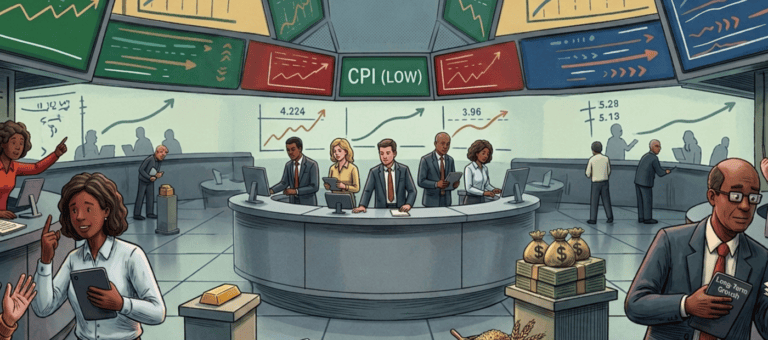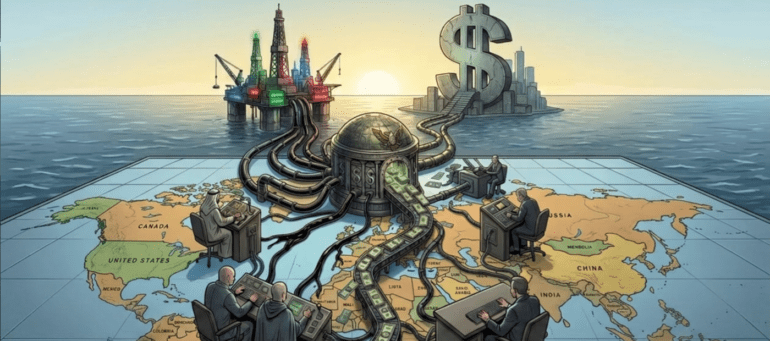
At the center of global financial markets sits a quiet but powerful structure – petrodollars, the reason oil is priced in U.S. dollars, and often the main explanation for why energy shocks ripple across currencies and bonds and why movements in crude oil often spill into equity indices within hours.
For traders, especially those operating under the requirements of funded trading programs, this system is more than just background noise. It is important context that can explain why volatility expands, why correlations shift, and why some trades work effortlessly while others fail despite looking technically sound.
This guide dives into this lesser-known but critical system to explain what it is, its history, and why it is important for futures traders, helping you make it work in your favor.
What are Petrodollars
Petrodollars are U.S. dollars earned from crude oil exports. These dollars are then “recycled” into global financial markets, mainly as investments in U.S. stocks and bonds, often through sovereign wealth funds.
The petrodollar system is the main pillar maintaining consistent global demand for the dollar. It guarantees the USD’s status as the primary global reserve currency and links oil prices directly to the USD’s valuation.
Today, petrodollars are among the primary sources of revenue for most OPEC members, as well as for non-OPEC oil and gas exporters, such as Russia, Qatar, and Norway.
However, it is also important to explain what the petrodollar is not. First, it isn’t a standalone currency. Next, it isn’t a global trading system either. While we can refer to petrodollars as a “system” (as above), it is simply a term that describes the USD-denominated proceeds from oil exports of sellers.
The History of Petrodollars
To understand why the petrodollar matters today, you need to go back to the early 1970s when the global monetary system underwent a profound shift.
In 1971, the United States ended the convertibility of the dollar into gold, effectively dismantling the Bretton Woods system. Suddenly, the dollar was no longer anchored to a tangible asset. To retain its global dominance, it needed a new foundation – something that would ensure a stable, or even increasing, global demand.
That foundation became oil. Through a series of agreements with major oil-producing nations, particularly Saudi Arabia, the U.S. secured a deal – oil would be priced and traded globally in USD. In return, oil exporters would reinvest their dollar revenues into U.S. financial assets, primarily Treasury bonds. This created what is now known as the petrodollar system.

Petrodollars: A Detail or the Whole Picture
At some point, every trader reaches that moment when markets stop feeling random. While price might still move unpredictably in the short term, the patterns beneath that noise start getting more evident – it might be oil spikes and the dollar strengthening, the bond yields reacting, equity indices wobbling, or emerging market currencies fluctuating wildly.
Often, such situations feel coincidental, but, in reality, they rarely are. Behind the moves sit petrodollars – a structure that has shaped global markets for decades and one that is highly likely you haven’t heard of.
The truth is, it’s not something most traders think about day-to-day, and it’s rarely the reason someone clicks “buy” or “sell.” However, if you ignore it long enough, you might start missing “the why” behind major moves. And in futures trading, especially in funded environments where consistency, discipline, and risk control are everything, that “why” becomes more than useful, serving as a filter to avoid low-quality trades.
So, back to the question – while petrodollars might seem more of a detail, they aren’t. Instead, this mechanism serves as an overarching force and among the most influential drivers behind global market behavior, linking energy pricing, currency demand, and capital flows into a single macroeconomic framework. Because oil is predominantly traded in U.S. dollars, shifts in energy markets directly impact dollar demand, liquidity conditions, and asset pricing across multiple asset classes.
For futures traders, particularly those in funded programs, this relationship provides a critical layer of context. It helps explain cross-market movements, refine trade selection, and manage risk in environments where energy dynamics often drive volatility.
Why the Petrodollar Matters in Today’s Markets
If you trade oil, USD, bonds, or equity indices, you’re basically already trading the petrodollar system, whether you realize it or not. This invisible thread connects energy markets to global liquidity, playing a central role in how capital moves across the financial system.
So, to put it simply, the petrodollar matters since it’s in the mechanics of the global economy:
- Countries and the entire economy run on oil
- Oil is priced in dollars
- Therefore, countries need USD
- Oil exporters accumulate USD
- Those dollars flow back into U.S. markets
This loop, referred to as petrodollar recycling, as mentioned above, is one of the pillars of global financial stability. It ensures continuous demand for the dollar and provides a steady stream of capital into U.S. assets.
Furthermore, global oil demand continues to be massive, which means that the same loop – oil demand driving dollar demand – still matters deeply, even if the geopolitical landscape has evolved.
It is worth noting that the importance of petrodollars isn’t just about oil pricing. Instead, it is about a structural force, embedded in global trade and capital flows, and the interconnectedness of today’s markets.
Here is an example of the ripple effects of rising oil prices:
- Importing countries need more dollars, leading to increased USD demand
- Inflation expectations rise, leading to bond yields moving
- Central banks adjust their forecasts, leading to equities reprice
- Risk sentiment shifts, causing increased volatility
In other words, oil becomes a trigger, and the dollar becomes the transmission mechanism.
Why Funded Traders Should Pay Attention to Petrodollars
If you’re trading a personal account, you can afford to be reactive, taking trades based purely on technical setups and adjusting over time. However, in funded trading programs like Earn2Trade’s Trader Career Path® and The Gauntlet Mini™, that approach is far less forgiving since there are rules to follow, such as:
- Daily loss limits
- Maximum trailing or end-of-day drawdowns
- Profit targets within defined periods
- Consistency requirements
The constraints you are operating under are there for a reason – to teach you how to get prepared for a professional funded trading career and demonstrate steady performance so that you can be successful in the long term. A critical enabler for this is understanding the context.
Experienced traders are masters of context. For example, they don’t treat markets as isolated silos but understand that crude oil, the USD, bonds, equities, and macro indicators are part of an interconnected organism that moves together. In that sense, understanding the mechanics behind the petrodollar concept helps you avoid trading against macro flows, giving you a directional bias, even before you look at a chart. For example:
- If oil is breaking out amid supply disruptions and the dollar is strengthening, you might expect pressure on equity indices.
- If oil is collapsing due to weak demand, you might anticipate relief for inflation-sensitive assets like bonds or tech stocks.
These examples are figurative and might not always materialise in said manner. However, the idea here is to emphasize that without context, you’re trading blindfolded. With it, you’re filtering trades before you even consider execution.
Which Futures Contracts Are Most Affected by the Petrodollar Dynamics
The petrodollar system doesn’t impact all markets equally – while its dynamics directly influence some futures contracts, others are affected more indirectly. For funded traders, these dynamics and market interconnectedness are critical. It allows you to trade not just individual markets, but relationships between them.
Here are a few examples of where it shows up most clearly:
- Crude Oil Futures (CL, Brent): This is the core of the system. Any disruption in supply, demand, or geopolitics feeds directly into price, and by extension, into global dollar flows.
- U.S. Dollar Index Futures (DX): Since oil is priced in dollars, shifts in energy markets often influence dollar demand. Strong oil markets can coincide with dollar strength, particularly during supply shocks.
- Treasury Futures (ZN, ZB): Petrodollar recycling often flows into U.S. bonds. When oil-exporting nations accumulate surpluses, they often invest in Treasuries, which can influence yields.
- Equity Index Futures (ES, NQ, RTY): Energy-driven inflation can affect interest rates, which, in turn, can affect equity valuations. As a result, rising oil prices might often pressure growth stocks and broader indices.
- Gold Futures (GC): Gold acts as a hedge against market instabilities and geopolitical risk. Its relationship with oil and the dollar can shift depending on market conditions.
- Currency Futures (6E, 6J, etc.): Oil-importing economies are sensitive to energy prices. When oil prices rise, their currencies can weaken due to increased demand for the dollar and strained fiscal and FX reserves.
How Traders Can Track the Petrodollar in Real Time
You don’t need a PhD in macroeconomics to track the petrodollar system. In fact, there are several indicators and steps you can follow to ensure you are alerted in a timely manner to noteworthy developments. Here are a few of them:
- Watch Crude Oil Performance Daily
This should be your go-to signal. Ensure you are paying close attention to potential breakouts and swift reactions to geopolitical news.
Another important thing is to keep an eye on the inventory reports. Useful resources on that front are the Weekly Petroleum Status Report, released by the US Energy Information Administration, as well as OPEC’s monthly reports. Data releases on US macroeconomic performance (e.g., inflation data) are also worth tracking.
- Monitor the U.S. Dollar Index (DXY)
The U.S. Dollar Index (DX/DXY) tracks the performance of the US dollar against a basket of other currencies in real time. Keep an eye out for potential divergences in oil performance or sudden trend shifts.
Make sure to also look for a demonstration of strength during risk-off events, as it is often indicative of a potential upcoming market reaction.
- Follow Geopolitical Developments and Track Treasury Yields
Energy markets are highly sensitive to Middle East tensions, OPEC+ decisions, sanctions and trade policies, military conflicts, tariff regimes, and political disruptions. So make sure to always be in the loop of what is happening across the leading oil-producing and exporting markets.
Furthermore, it is important to track yields, as they reflect inflation expectations and capital flows. For example, rising yields during oil rallies might often confirm that macro pressure is mounting.
- Observe Cross-Market Correlations
As mentioned at the start, the petrodollar mechanism extends beyond oil to a wide range of sectors. That is why it is important to monitor other markets for early warnings.
For example, one thing you can do is look for alignment across oil, yields, and equities. If oil and yields rise while equities fall, it would be a strong macro signal. On the other hand, if the signal is mixed, the conviction would be lower.
A Practical Example of the Petrodollars’ Health and How Its Monitoring Can Translate into Trades
While there is no single “petrodollar index” to track and base your trading decisions on, you can consider monitoring a range of different indicators that can give you a sense of its strength.
For example, one of them is the U.S. Dollar Index (DXY), which reflects the global demand for USD. Another is oil prices, which help gauge energy-driven dollar flows, while the state of FX reserves is a good indicator of global reliance on the USD.
Make sure to also consider treasury yields and TIC data, as they can indicate the state of capital recycling (investments) into bonds and foreign investments in the United States, respectively.
Last but not least, keep track of the gold vs oil ratio as it can signal the market sentiment and the confidence in fiat vs commodities.
So, if most (preferably all) of these elements move in sync, the petrodollar system is likely functioning as expected. However, if they diverge, it might signal that something is changing, giving you a reason for caution and fueling expectations for upcoming opportunities (respectively increased risks or uncertainty).
You can also consider the geopolitical and macroeconomic situation for additional context. For example, if there is an oil supply shock (e.g., due to a war or energy market disruptions like those following the Strait of Hormuz crisis, which we have covered in detail), the oil and the USD often tend to move in line. This can sometimes result in a trade bias that fuels the narrative of shorting equities and going long on oil. Or if oil demand slows and recession fears emerge, oil and USD can decline in sync, prompting traders to consider going long bonds and being cautious with equities. And in most cases, when the energy markets remain stable, the oil and USD remain neutral, prompting traders to focus on micro setups instead.
So, in a nutshell, there is no single trading system to follow to capitalise on the opportunities stemming from the state of the petrodollar mechanism. Instead, the key is understanding the driver behind the move, because in trading, the same price move can mean very different things depending on context.
The Future of Petrodollars: Would They Remain Relevant in the Future?
Over the past few years, there has been a growing debate over whether the petrodollar is needed and will remain relevant in the current global context.
While there isn’t a strong consensus on its future, oil exporters continue to prefer the USD because of its established status as a global investment currency. As a result, it is the most convenient and reasonable store of value for oil revenue, which nations also use to earn returns on.
Besides, sovereign wealth funds are deeply engaged in reinvesting their petrodollars in stocks, bonds, and other financial instruments. A case in point is Norway’s sovereign wealth fund, for example. It remains the largest globally, with a value of around USD 2.2 trillion at the end of 2025, up from about USD 2.08 trillion a year earlier. It has invested in over 7,200 companies across 60 countries and has stakes in around 1.5% of the world’s publicly listed stocks. In 2025, it bet big on Big Tech stocks and banking, generating a 15.1% return.
Furthermore, experts have highlighted moral concerns about petrodollars, including their use to fund military operations and human rights violations. While the first petrodollar recycling operation took place in 1974, with Saudi Arabia investing its proceeds in U.S. Treasury bonds, subsequent deals included financing weapons purchases.
Besides, countries have been trying to rival the petrodollar by introducing alternative mechanisms. One example is the petroyuan, oil exports denominated and paid for with Chinese currency, introduced in 2018. However, it still faces challenges. For example, while USD from crude exports can be easily invested globally, including in the massive eurodollar market for short-term dollar-denominated deposits in European banks, oil export proceeds in Chinese currency can’t be invested outside China as freely as the USD. Furthermore, they can be invested only within China’s economy, at the discretion of the Chinese government. And at that point, even despite the recent boom in Chinese capital markets, they remain much smaller and less liquid than those of the U.S. and Europe.
As a result, the petroyuan market remains a small fraction of total global trade compared to the USD, although a Deutsche Bank analysis following the start of the war in Iran predicted a rise of the petroyuan, further prompting discussions about a potential de-dollarization.
So, to sum up, while the petrodollar might have become less influential and holdings have dropped, a collapse seems highly unlikely as it remains the top global reserve currency, with no real competition. As of Q3, 2025, it accounted for 56.92% of the global allocated currency reserves, as per data by the IMF.
Understanding the Petrodollar’s Importance as Market Infrastructure Critical to Improving Trading Performance
Think of the petrodollar system as the infrastructure beneath financial markets. While it’s not the visible road you drive on, it’s the ground and the foundation that support it. Most of the time, you won’t notice it, but once it shifts, which it ultimately will, you will feel the impact.
So, for funded traders and participants in funded trading programs, understanding this infrastructure means being able to recognize when conditions are stable and when they’re not, ultimately leading to better trading decisions. Because when you understand the macro backdrop, you’re less likely to chase random breakouts, trade against strong flows, and overreact to noise.
Instead, you will become more selective. And in funded trading programs like Earn2Trade’s Trader Career Path® and The Gauntlet Mini™, which aim to equip you with everything needed to succeed as a professional trader, selectivity is critical. At the end of the day, you’re not judged on how many trades you take, but on how well you manage risk and execute your edge. So, don’t focus exclusively on refining entries, indicators, and setups, but ensure that you are able to understand the underlying system and the context it provides. Because context turns randomness into structure, and structure is where opportunities usually reside.