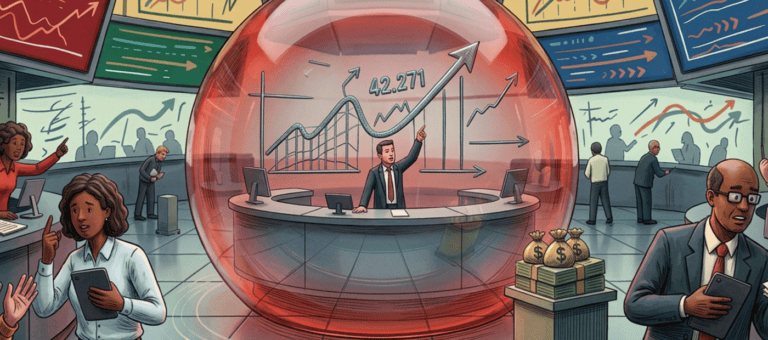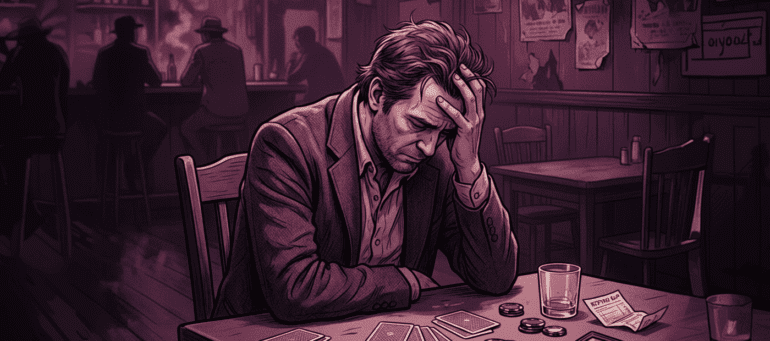
Imagine the following situation: you’ve identified valid setups, the entry conditions all met your criteria, and the execution was good, yet you suffered three losses in a row. The market just didn’t follow through. Then you sit back, glance at your daily drawdown, and feel the pressure to compensate, saying to yourself: “It can’t keep doing this. The next one has to work.”
That sentence alone has ended more funded accounts than bad indicators, poor charting, or lack of market knowledge ever will. This is the gambler’s fallacy in the flesh – the belief that after a sequence of losses, you are owed a win.
Every funded trader has, at some point, had a moment like this. However, not everyone can recognize it.
This guide uncovers everything you need to know about the gambler’s fallacy and its impact on trading performance. You will learn what makes it so common, how to spot its initial signs, and most importantly – how to protect your account.
What Is the Gambler’s Fallacy
The gambler’s fallacy, also known as the “Monte Carlo” fallacy, describes the false belief that past outcomes determine future ones, reflecting the human tendency to seek patterns in randomness. Alternatively, it forces the brain to think that, if a particular random event occurred more frequently than usual in the past, it is “due” to occur less frequently in the future.
The gambler’s fallacy was first identified by the French mathematician, astronomer, and physicist Pierre-Simon Laplace, back in 1820. He termed it “the illusion in the estimation of probabilities,” describing it as the mistaken belief that independent, random events are self-correcting. The cognitive bias gained broader attention after a 1913 Monte Carlo Casino incident, in which 26 consecutive black roulette spins led to massive losses as bettors wrongly believed red was “due.”
The gambler’s fallacy stems from humans’ firm belief in small numbers, where small sample sets are always considered representative of outcomes.
In the trading world, this bias often materializes through the idea that if you have suffered a series of losses, a win is about to come next. As a result, some traders might end up selling after a series of gains, mistakenly believing that the previous market jump signals a decline is around the corner. However, in reality, past and future events are independent of each other, and you shouldn’t be looking at the former to predict the latter.
Why Our Brains Don’t Like Randomness
As humans, we aren’t built for probabilistic thinking, but are more like pattern-detection machines. This is deeply rooted in our evolution because spotting patterns has always helped increase survival – e.g., if bushes rustled three times in the same place, it was safer to assume a predator was nearby.
The gambler’s fallacy makes you ignore the fact that past and future events are entirely random. Instead, it forces your brain to stick with the idea that the past determines the future – e.g., the next event’s outcome will oppose that of the previous ones.
However, in reality, each event, whether past or future, is independent of the others and irrelevant to determining the probabilities of what will happen next.
For example, consider a situation where you flip a coin 10 times in a row, all ending with the “tails” side up. Your brain is very likely to then assume that the next coin flip will finally give you “heads,” since “it’s been a while.”
However, in reality, the chance of landing on either side is still 50/50. There is no systemic relation between the two potential outcomes and how frequently they have repeated in the past. In other words, each flip is an independent, random event.

The Presence of the Gambler’s Fallacy in Funded Trading and What Makes It Dangerous to Your Performance
Financial markets are complex probabilistic systems in which randomness and event independence dominate. For example, even if a properly structured trading system has a 45% win rate, it doesn’t mean wins and losses will alternate neatly. They can cluster or streak, or take turns, often behaving in ways that might feel unfair or irrational.
Let’s get back to the example with the coin – if you flip it 100 times, there is a very high probability that you will see at least one streak of five consecutive heads or tails. There is nothing strange in this – it’s mathematically expected. However, if you experience five losses in a row in your Earn2Trade account, you might start feeling like something is broken.
And that’s exactly the essence of the gambler’s fallacy – it fools us into believing that balance must occur immediately. However, your next trade won’t be determined by the previous ones – it is instead an independent event with a random outcome.
What makes trading uniquely challenging is that, unlike roulette, markets do have underlying structural forces, such as trends, liquidity, volatility, macro catalysts, black swan events, etc.
That nuance creates confusion, leading traders to believe that, because markets trend and rotate, short-term reversals must follow streaks. But statistical independence applies to your system’s outcome distribution, not necessarily to price direction in isolation.
The key distinction here is that, even if market conditions evolve, your strategy’s next outcome remains probabilistic rather than compensatory. Your last three losses won’t automatically increase the likelihood that your next setup will work. What they are likely to increase, however, is your emotional sensitivity to the outcome.
In the structured environment of funded trading evaluations like Earn2Trade’s Trader Career Path® and The Gauntlet Mini™, failing to understand this can significantly affect your performance.
The situation is no different once you pass the evaluation and become a funded trader. At that point, you might start experiencing the subtle belief that consistency should now follow your every move naturally. However, when it doesn’t, cognitive dissonance can intensify, prompting you to question whether something is wrong. But very often, nothing is wrong – it’s just the gambler’s fallacy dictating your perception of the market.
Funded Traders Can Be More Vulnerable Than Retail Traders
The structure of funded trading programs is designed to prepare you for “the real world.” As a result, it can magnify the impact of psychological distortions on your performance. The imposed rules, such as strict daily loss limits and trailing drawdowns, leave no room for emotional escalation.
Let’s say your daily loss limit is $2,500 and you suffer a series of consecutive losses. While you might still be compliant with your program’s rules, the margin is starting to feel thinner, ultimately increasing psychological pressure.
On the other hand, retail traders with personal capital can deposit more money if they miscalculate risk.
High-pressure situations are where the gambler’s fallacy thrives. Participants in funded trading programs who find themselves in the situation described above often act emotionally rather than rationally. Instead of thinking in terms of long-term expectations, their time horizon compresses, and they start calculating how to “get back to green” right away, often within the same trading session. This can prompt them to widen the setup criteria or slightly increase position size, and even justify a marginal setup because “statistically,” a win should be coming. However, in reality, a 50% win-rate strategy still has a 50% chance of losing the next trade after five losses.
In funded programs, another factor that compounds the issue is visibility. Many traders feel accountable to the firm, to a community, or even to social media. Passing the evaluation can also often create a sense of identity elevation, and losing streaks threaten that identity. This makes recovery feel urgent rather than procedural.
This loss aversion often increases under externally evaluated performance environments. When individuals feel observed, they are more likely to take risks to quickly restore status.
The “Recovery Trade” as the Real Danger
The gambler’s fallacy rarely presents itself as reckless gambling. Instead, it shows up disguised as a strategic adjustment. For example, after four red trades, you increase just slightly – from two contracts to three, telling yourself that your edge is intact, and when it hits, you’ll recoup faster. This escalation is driven by emotional mathematics.
Professional traders understand that expectancy plays out over large samples – e.g., over 100 trades and not five.
Yet under pressure, we compress distribution thinking into sequence thinking, confusing long-term statistical inevitability with short-term compensation.
Instead of first focusing on protecting what you have, as every professional does, the gambler’s fallacy prompts you to prioritize restoring what was lost immediately. However, in funded trading, protection is survival.
So, to ensure you are well-positioned to survive first and thrive later, it is critical to avoid revenge trading (learn more about its risks here). In essence, what makes the recovery trade particularly destructive here is asymmetry – after several losses, your cushion shrinks, and increasing position size at that moment will only multiply the impact when your tolerance is lowest.
The psychological need to “erase” red numbers often overrides logical sizing discipline. But it’s critical to understand that most account violations don’t happen because traders lack knowledge. Instead, they happen because traders believe urgency justifies deviation from their plan and losing their cool. In such a situation, the recovery trade feels courageous and necessary, but, in hindsight, it’s almost always impulsive and reckless.
How the Gambler’s Fallacy Works in Practice: An Example
Funded traders that succumb to the gambler’s fallacy don’t do so instantly, but let it escalate gradually until the point when it breaks structural limits. Here is an example:
| Stage # | Internal Narrative | Behavioral Shift | Risk Consequence |
| 1 | “Normal variance.” | Discipline remains intact | Controlled |
| 2 | “This is frustrating.” | Minor hesitation creeps in | Emotional load intensifies |
| 3 | “Something feels off.” | Second-guessing the strategy | Execution becomes inconsistent |
| 4 | “It’s due.” | Increasing position size or loosening setup criteria | Increased exposure |
| 5 | “I need to do something. I need to recover!” | Aggressive trade placement | High structural risk |
| 6 | Rule violation | Consequences for your account | Eroding your progress |
Of these, each step feels minor, and no single decision feels catastrophic. But compounded together, they shift your risk profile dramatically.
Professional traders interrupt the ladder early. For example, they recognize stage three as a signal to reduce intensity, not increase it.
Still, if you end up reaching stage #6, don’t be all “doom and gloom.” Instead, use it as a stepping stone and learn your lesson – the next time, you won’t be revenge trading if you play your cards right.
Six Simple and Practical Defensive Strategies Against the Gambler’s Fallacy
While biases can’t always be eliminated, they can be minimized or even neutralized structurally. There are several strategies that you can try, including:
- Position-size immutability during drawdowns – consider predefining a reduction threshold. For example, after three consecutive losses, reduce position size by 25% (or another threshold) for the next five trades.
- Build a “variance log” – document every losing streak and compare it to historical data. Seeing repetition will ultimately reduce emotional shock. Journaling can be a great help for this – here is a dedicated guide on the best practices.
- Implement forced pauses – research on stress physiology shows that even short physical resets (e.g., standing, walking, controlled breathing, etc.) can significantly reduce impulsive decision-making and improve your performance.
- Track rule adherence separately from P&L – if you followed your process perfectly during a losing streak, your performance grade will remain high. Stick to this, and you will be able to successfully separate identity from outcome.
- Don’t try to win back losses – losses are part of the game, and they should be treated independently of wins, not as some sort of sequence that will ultimately be broken because it “has to.” The market doesn’t care about your recent pain and won’t reward you for it.
- Follow your strategy meticulously – it is rigorously backtested (if it isn’t, be quick to correct that) and the strict buy and sell signals are there for a reason. Your strategy is a byproduct of independent research, and you shouldn’t let emotions override this – instead, stick to the plan and trust the process.
To Wrap Up: Trust in Independence to Break Free From the Gambler’s Fallacy
The gambler’s fallacy is a byproduct of perceiving patterns that don’t exist. To break free from it, it is critical to understand that each event is independent (even random) and that past occurrences don’t have any impact on future probabilities or outcomes.
This foundational, yet emotionally counterintuitive principle can make or break your account’s performance. Despite the urge to feel a connection between trades because they are temporally close, it is necessary to lean on statistics and distribution thinking and detach from any sequence narratives.
Markets can trend irrationally longer than you expect – volatility regimes shift, liquidity conditions change, and none of that guarantees immediate compensation for recent losses. So, the next time you hear “It has to turn now,” recognize it as a cognitive warning light.
At the end of the day, it is important to understand that your goal isn’t to be right quickly, but to be right over the long term. That is why funded trading programs like Earn2Trade’s Trader Career Path® and The Gauntlet Mini™ teach you not to speed up because you lost or slow down because you won, but to have the discipline to execute only when your setup fits your strategy’s requirements. That is what separates successful funded traders from those who recycle evaluations.