The first thing you notice in an energy crisis isn’t the charts – it’s the speed. One moment, crude oil is grinding sideways, respecting levels like any other market. The next, it’s ripping vertically, slicing through resistance as if it never existed. No pullbacks, no structure, just velocity. In situations like these, it isn’t the direction that catches most traders off guard, but the character of the move.
The second thing you notice is how quickly your usual framework starts to break down – indicators lag, support and resistance lose precision, and even your market intuition starts to feel unreliable. That’s because energy market shocks don’t just increase volatility but fundamentally alter market behavior, making liquidity uneven, spreads widen, and price discovery chaotic.
The ongoing events in Iran have triggered exactly this kind of environment. Aside from yet another geopolitical headline, it’s a structural disruption to one of the most critical supply chains in the global economy. Oil isn’t reacting in isolation – it’s pulling the entire macro landscape along with it. Bonds, equities, currencies – everything is recalibrating in real time.
For funded traders, situations like these create a paradox. There might be larger ranges, stronger trends, more inefficiencies, but there are also greater risks. A single mismanaged trade can instantly violate drawdown limits and derail your account.
In such an environment, you can’t rely on habit but have to trade consciously, deliberately, and with a high level of precision. Because if you can learn to operate in situations like these, when conditions are unstable, narratives are shifting, and volatility is elevated, you will build the kind of resilience that defines long-term success.
The Anatomy of an Energy Market Shock
Energy market disruptions, such as oil shocks, don’t happen in a vacuum but emerge from a chain reaction of geopolitical, logistical, and psychological factors that compound rapidly.
For example, the current crisis in Iran illustrates the fragility of the energy market and the vulnerabilities inherent in the global oil system. The market operates on small margins, and even a small disruption of like 2–3% of global supply can trigger outsized price reactions.
One reason is that oil demand is highly inelastic in the short term. For example, people won’t suddenly stop driving, nor will petrol-reliant industries halt production overnight. So when supply is threatened, prices must adjust aggressively to rebalance the equation.
Now layer on top of that the geopolitical dimension. Iran isn’t just another oil producer – it is among the top five in terms of global output with around 5%, as well as the third-leading gas producer, with a share of 6.4%.
Furthermore, it sits at the center of one of the most strategically important regions in the world. The Middle East, as a whole, accounts for roughly 40% of global oil exports. Around 20% of global crude oil deliveries pass through the Strait of Hormuz, a critical chokepoint that Iran has closed. Furthermore, strikes on energy infrastructure across Qatar, Saudi Arabia, and Iraq further threw oil supplies into a disbalance.
The current situation features multiple escalation paths, each with increasingly severe consequences, creating a persistent uncertainty premium that keeps volatility elevated even in the absence of new headlines – because in situations like these, markets aren’t just pricing in current disruptions but also the risk of systemic failure and future scenarios.
For traders, the key takeaway is this: oil shocks are not linear. They don’t unfold in a straight line from cause to effect. They evolve in waves: an initial reaction, reassessment, overreaction, and eventually, stabilization. Understanding which phase you’re in is often more important than predicting direction.

A Familiar Pattern: History Rhymes in Oil Markets
Over the years, geopolitical events have sent shockwaves through energy markets on numerous occasions.
For example, during the first oil crisis (1973–1974), triggered by an OAPEC embargo against nations supporting Israel in the Yom Kippur War, global oil prices nearly quadrupled, rising from around $3 to over $12 per barrel by January 1974, triggering intense global economic recession, high inflation, and significant energy shortages.
Another example is the 2011 tensions in Iran, which traders viewed as an immediate threat to oil market supply, triggering an initial price jump of 1-4%, which then faded as no disruptions actually occurred.
However, this isn’t always the case. In 2022, when the Russia–Ukraine war started, the market experienced a structural supply shock that prompted a 30%+ sustained rally and extremely high multi-week volatility, proving that true supply shocks create trends, not just short-term moves.
There’s a tendency to treat every geopolitical crisis as unique, and in many ways, it is. The players change, the political context shifts, and the global economy evolves. But when you look specifically at oil markets, the behavioral patterns are remarkably consistent.
- Phase 1: The shock
A headline hits (e.g., a regulation, a military conflict unfolds, an economic sanction, etc.), and oil spikes sharply. This move is driven less by fundamentals and more by fear, with traders rushing to price in worst-case scenarios, often overshooting what is realistically expected to happen.
- Phase 2: Digestion
Market participants begin to assess the actual impact. Is supply truly disrupted, or is the threat exaggerated? Are alternative routes or reserves available?
During this phase, volatility remains high, but price action often becomes choppier. This is where many traders get trapped, buying tops or selling bottoms as narratives shift.
- Phase 3: Resolution
Or at least temporary stabilization. Either the situation de-escalates, or the market becomes comfortable with the new normal. Prices begin to consolidate or trend more cleanly.
Where Are We Now?
What’s interesting about the current environment is that we seem to be oscillating between phases one and two repeatedly. Each new development resets the cycle, preventing the market from settling into a stable regime. That’s why volatility remains elevated for longer than usual.
For traders, historical context provides an edge not because it predicts the future, but because it sets expectations. When you recognize that an initial spike is likely to be followed by a period of consolidation or retracement, you’re less likely to chase momentum mindlessly.
At the same time, history also teaches caution. There are moments when the pattern breaks and when a shock evolves into a sustained structural shift. Those are the environments where trends extend far beyond expectations. Distinguishing between a temporary spike and a lasting disruption is one of the hardest and most valuable skills in trading.
When Oil Moves, Everything Moves
Oil is often referred to as the “lifeblood of the global economy,” and that’s not an exaggeration. It’s embedded in transportation, manufacturing, agriculture – virtually every sector depends on it in some way. So when oil prices move sharply, the effects ripple outward almost immediately.
One of the first areas impacted is inflation. Higher oil prices translate into higher transportation and production costs, which eventually get passed on to consumers. This pushes inflation expectations higher, which in turn influences central bank policy. Suddenly, rate cuts that seemed imminent are delayed, or, in some cases, taken off the table entirely.
This shift in expectations has a direct impact on bond markets. Yields can rise as investors demand higher returns to compensate for inflation risk. Equity markets might react as well, particularly growth stocks, which are sensitive to interest rates. At the same time, sectors such as energy and commodities may outperform, creating market divergence.
Currencies also come into play. Oil-exporting countries often see their currencies strengthen, while oil-importing nations face pressure. The US dollar, as the global reserve currency, can behave in complex ways, sometimes strengthening amid risk aversion and other times weakening amid inflation concerns.
For funded traders, this interconnectedness is both a risk and an opportunity. It means that trading oil isn’t just about oil, but about trading the macro environment. However, it also means you have additional tools for confirmation (e.g., if multiple markets are aligning with your thesis, your confidence in the trade increases).
The Energy Market Reaction to the Iran War
As of January 30, the global benchmark Brent crude was trading at around $70 a barrel, up around 11% since the start of the month. Between February 28 and March 3 (the first days of the conflict), it surged to $83 a barrel, an increase of 15% for the period. Global LNG prices increased 25% between February 28 and March 3. At $112 a barrel on March 22, Brent crude jumped 54% above its level before hostilities began, while gas prices in Europe rose by 85%.
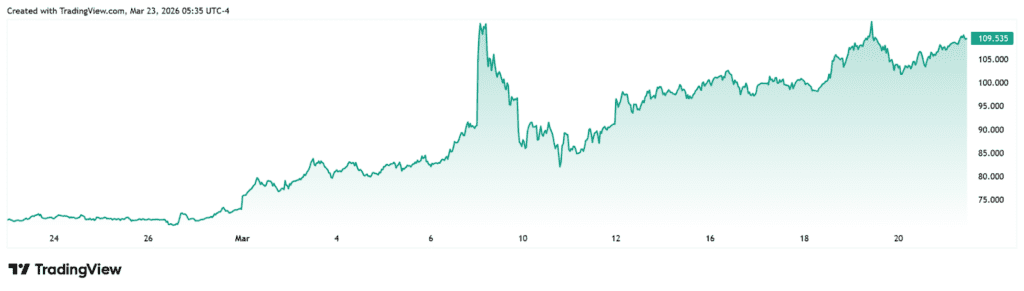
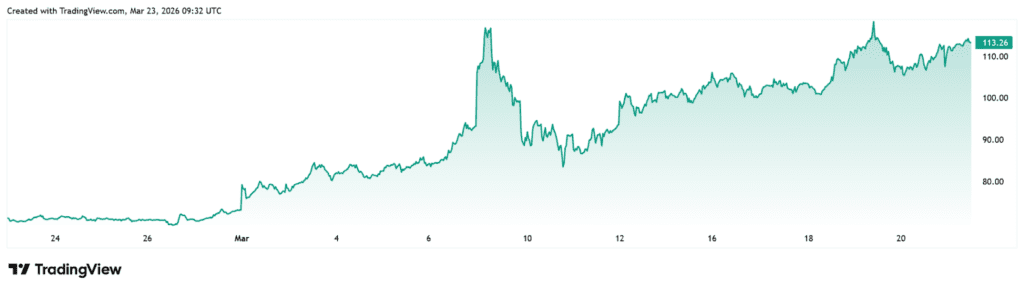
The chief of the International Energy Agency likened the current situation to the 70s twin oil shocks and the fallout from the Ukraine war. The numbers confirm his projections. JP Morgan forecasts oil prices reaching $130 per barrel, matching the all-time high seen during the 2007-2008 oil shock, while Wall Street analysts project levels of up to $200 per barrel. Iraq’s Deputy Prime Minister has warned that prices could reach $300 per barrel.
According to the Economist, even the best-case scenario for energy markets is disastrous, and whatever happens, high prices will outlive the Iran war.
An analysis by Bloomberg Economics projects that, in a severe scenario, energy prices would remain high through the fourth quarter of the year. If the deep disruption to oil and natural gas supplies continues, it threatens to unleash a global wave of inflation, experts note. Ultimately, sharply higher oil prices will impact the economy through higher consumer and business costs, reduced purchasing power, higher transport and petrochemical prices, and a hit to GDP growth.
The Funded Trader’s Reality: Why Such Situations Might Seem Brutal
Funded trading programs like Earn2Trade’s Trader Career Path® and The Gauntlet Mini™ are designed to give you the tools to become the best version of yourself as a trader. As a result, they are fundamentally different from trading your own capital. The rules are stricter, the margin for error is smaller, and the psychological pressure can seem significantly higher. And while in a normal market, these constraints are manageable, in a volatile energy market, they can become a serious challenge.
Among the biggest issues is the mismatch between market volatility and account limits. Since oil can move several dollars in a matter of minutes during a crisis, it can quickly push your account dangerously close to your drawdown limit if your position size isn’t adjusted accordingly.
There’s also the issue of execution. In fast markets, slippage becomes more common as stops may not get filled at the exact level you expect. This introduces additional risk that isn’t always accounted for in backtesting or planning.
Psychology plays a huge role as well. When markets are moving quickly, there’s a temptation to trade more frequently and chase moves to make your losses back quickly. In a funded account, this behavior is often fatal as one or two impulsive trades can erase weeks of disciplined performance.
Another factor is consistency, since many funded programs require traders to demonstrate steady performance over time, and high-volatility environments can often lead to erratic results. For example, a trader might have a few large winning days followed by significant drawdowns, which can be problematic from an evaluation standpoint.
The solution isn’t to avoid trading altogether but to adapt. This might mean trading a smaller size, focusing on fewer setups, or even sitting out during the most chaotic periods when discipline becomes more important than ever. Fortunately, funded trading programs like Earn2Trade’s Trader Career Path® and The Gauntlet Mini™ are the best training grounds to help you learn how to navigate such situations without risking your capital, so that you can be prepared once you enter the real world.
The Psychology of Oil Shocks: Why Traders Get It Wrong
Even the best strategies can fail if psychology isn’t managed properly. In high-volatility environments, emotions tend to amplify as fear, greed, and frustration intensify, influencing decision-making.
One common issue is overconfidence after a winning trade. A trader catches a strong move and begins to feel invincible. This often leads to increased risk-taking, which can quickly lead to accumulated losses.
On the other hand, losses can trigger revenge trading. The desire to recover quickly leads to impulsive decisions, often compounding the problem.
However, living near a fault line teaches you a valuable lesson: you can’t control the environment, but you can control your preparation.
The same applies to trading oil during a crisis – you don’t know when the next major move will occur, but you know it will. By building robust risk management and disciplined execution, you create a system that can withstand shocks.
This highlights an important shift in mindset where awareness is the first and most crucial step. As you learn to recognize these patterns, you will get better at interrupting them in various ways, including stepping away from the screen after a significant win or loss, or sticking strictly to predefined rules.
In a nutshell, instead of trying to predict and control, you will focus on resilience and adaptability.
Before we dive into some basic strategies to help you navigate energy market disruptions, let’s take a minute to make one thing clear – preparation begins before the market opens. We can’t stress this enough!
While execution is where everything comes together, it is critical to have a solid playbook that instils structure and consistency, especially in chaotic markets (e.g., understanding the current geopolitical context, identifying key levels, and being aware of scheduled events all contribute to better decision-making).
During the session, the focus should be on patience and precision. Wait for setups to develop, confirm signals, and execute with discipline. Avoid the temptation to trade every movement, and don’t forget that risk management remains central, since in volatile markets, preserving capital is the priority. Keep position sizes appropriate, use stops effectively, and avoid overexposure. After the session, review your performance. Identify what worked, what didn’t, and why.
Now, let’s explore some practical tips.
Strategy #1: Trade the Reaction, Not the Headline
In fast-moving markets, information is priced in almost instantly. By the time a headline reaches you, algorithms and institutional traders will probably have already reacted. This is why chasing news-driven moves is one of the most common and costly mistakes.
Instead, try to focus on how the market reacts after the initial move. Does price continue in the direction of the spike, or does it stall? Are buyers stepping in aggressively, or is the move losing momentum?
One effective approach is to wait for structure to form. After an initial spike, the market often enters a consolidation phase. This creates identifiable levels (e.g., ranges, support, resistance, etc.) that can be traded with greater clarity, as breakouts or breakdowns originating from them may have a higher probability than the initial move.
Volume is another important factor. A strong continuation move is usually accompanied by high volume, indicating broad participation. On the other hand, if it declines, it may signal exhaustion, increasing the likelihood of a reversal.
This approach requires patience, and even if you miss the first part of the move, you might be able to gain a higher-quality entry that could be beneficial in the long term.
Strategy #2: Understand the “War Premium”
The concept of a “war premium” is central to trading oil during geopolitical crises. It represents the additional price component driven by uncertainty and risk, rather than actual supply and demand.
This premium can expand rapidly when tensions escalate, as traders begin to price in worst-case scenarios (e.g., disruptions to shipping routes, infrastructure damage, humanitarian crises, broader regional conflict, etc.). Even if these scenarios don’t materialize, the mere possibility and the masses’ reaction to them are often enough to push prices higher.
At some point, however, the market begins to reassess. If the feared disruptions don’t occur or alternative supply sources are secured, the premium starts to contract, which can lead to sharp reversals that catch traders off guard. But the key is – in situations like these, you often aren’t trading price, but perception.
For traders, the challenge is identifying when the premium is expanding rather than peaking. This often comes down to sentiment and positioning – e.g., if the market is overwhelmingly bullish and reacting strongly to minor news, it may indicate that the premium is already inflated. Conversely, if prices remain elevated despite calming headlines, it may suggest that underlying risks are still being priced in. However, every situation is different, so take this with a grain of salt.
Strategy #3: Reduce Size, Increase Selectivity
Reducing your position size is one of the simplest adjustments you can make in volatile markets, yet one of the most powerful. While it might seem so, note that this move isn’t about being conservative but about aligning your risk with current conditions.
However, reducing size is often critical because, as volatility increases, the range of price movements widens, so your stop-loss distances need to be broader to avoid being stopped out by normal fluctuations. By reducing size, you maintain consistent risk while accommodating larger price swings, effectively allowing you to stay in trades longer and avoid being shaken out prematurely.
On the other hand, if you decide to keep your position size the same, your risk per trade might increase significantly.
Selectivity is equally important, as in high-volatility environments, not all setups are worth trading. To limit overtrading and emotional trading and maintain discipline, it’s especially important to focus on a few high-quality opportunities rather than trade every movement.
Just learn from the playbook of professional traders who often become more patient during these periods. They wait for clear setups, align multiple factors, and execute with precision. Although this approach may result in fewer trades, it often leads to better outcomes.
In the words of the great Paul Tudor Jones,
The most important rule of trading is to play great defense, not great offense.
Strategy #4: Use Correlation as a Confirmation Tool
Correlations provide context by helping you understand whether a move is isolated or part of a broader market shift. In energy-driven market environments, this context becomes particularly valuable.
For example, if oil is rising and bond yields are also increasing, it might signal an inflation spike. And, if equity markets are declining at the same time, there might be broader risk aversion that can increase confidence in your trade.
However, that might not always be the case and is highly situation-specific. It is worth noting that correlations aren’t static and can weaken or even reverse, especially during periods of extreme volatility. This is why it is important to use them as a confirmation tool rather than a primary signal.
One practical approach is to monitor a small set of key markets alongside oil, such as bond yields, a major equity index, the USD, gold, etc. By observing how these markets react, you can gain additional insight into the underlying drivers of price action (e.g., if signals are mixed, it may be a sign to stay cautious).
Strategy #5: Think in Scenarios, Not Predictions
Making predictions is seductive, and that’s why everybody makes them, especially on social media. It gives a sense of control in an uncertain environment. However, in reality, markets are too complex and geopolitical events are too unpredictable for precise forecasting, even for the parties directly involved. So, to think that you will be able to predict what will happen next is… optimistic, to put it mildly.
Scenario thinking offers a better alternative. Instead of committing to a single outcome, you prepare for multiple possibilities and design a corresponding action plan for each scenario.
For example, in the case of a major geopolitical conflict, you might define three scenarios: escalation, stabilization, and de-escalation (here is a great blueprint by Bloomberg Economics’ analysts). For each one, you outline how you would trade, including specific levels, setups, and risk parameters.
This approach has several advantages. For example, it reduces emotional decision-making, as you’re not reacting in real time but executing a pre-defined plan. Furthermore, it also increases flexibility, allowing you to adapt as new information emerges.
Over time, this mindset becomes a competitive advantage and, while other traders are busy trying to predict the next move, you will be prepared for whichever direction the market takes.
To Wrap Up
Volatility is often viewed as risk, but it’s also the source of opportunity, since larger price movements can also create the potential for greater returns, but (and that’s a big but) only if managed correctly.
In the end, trading energy market disruptions isn’t about being bold but about being smart and patient. The goal isn’t to catch every move or predict every outcome. It’s to manage risk effectively and capitalize on high-quality opportunities.
Unfortunately, global geopolitical events often create challenging environments, and while we can’t avoid them, we can learn from them. In markets like these, survival isn’t just the first step – it’s the foundation for everything that follows. Earn2Trade’s Trader Career Path® and The Gauntlet Mini™ can give you the bricks for laying those foundations.