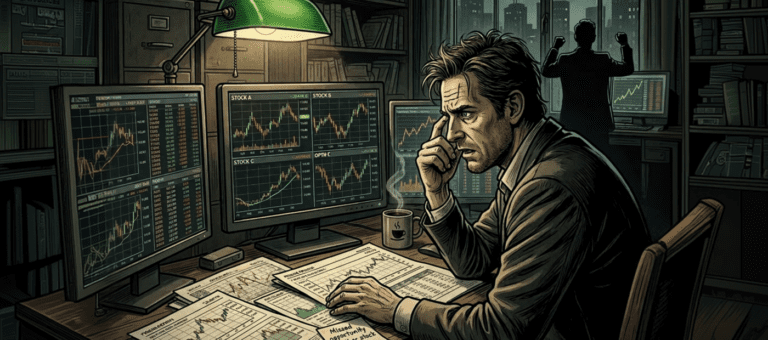
There’s a moment every funded trader knows perfectly well – you enter a trade that matches your setup ideally, with a clean context and well-defined risk. The market begins moving in your favor, and you’re up a respectable amount (e.g., enough to cover the losses from the previous day). Then the price pulls back slightly, and you get scared, no longer thinking about the opportunity ahead, but focusing on protecting what you’ve already made. The unrealized profit starts to feel emotionally “owned,” and every tick against you feels painful, so you decide to close the trade early, locking in a small gain. Minutes later, the market explodes in the original direction without you.
Then, a few hours later, a different setup appears. Since the previous made you cautious, this time, you hesitate and enter late. The trade fails and, instead of cutting the loss quickly, you hold on, hoping the price will recover as it did before. However, by the end of the session, you’ve done the exact opposite of what profitable trading requires – you cut the winner short, held the loser too long, and traded emotionally instead of systematically.
This, ladies and gentlemen, is loss aversion bias in action. And in funded trading, it quietly destroys more accounts than bad strategies ever will. This guide will explore what loss aversion is and why it is so dangerous for funded traders and participants in funded trading programs such as Earn2Trade’s Trader Career Path® and The Gauntlet Mini™. Importantly, we will provide actionable tips and strategies that you can try out to timely identify and address this common and tricky psychological bias. Let’s dive in!
What Is Loss Aversion Bias?
Loss aversion is one of the foundational concepts in behavioral finance. Introduced by the psychologists Daniel Kahneman and Amos Tversky in Prospect Theory (1979), the concept argues that we feel the pain of losses more intensely than the pleasure of equivalent gains. In fact, according to their research, humans experience losses at twice the emotional intensity of equivalent gains.
For example, losing $1,000 usually feels significantly worse than winning $1,000 feels good. That’s how loss aversion explains why traders become irrationally aggressive or overly cautious after a losing streak.
In everyday life, this bias influences countless decisions – holding onto failing investments, avoiding necessary risks, or clinging to certainty even when it limits opportunity.

Why Loss Aversion Is So Dangerous in Trading
As humans, our brains are wired to avoid pain as a survival mechanism, and trading is no different. However, successful trading requires accepting losses as a normal part of the process and learning to operate comfortably in an environment where pain is unavoidable.
Loss aversion is especially dangerous since it rarely feels irrational at the moment, as most traders genuinely believe they are being cautious, responsible, or defensive. For them, protecting profits sounds smart, while avoiding losses sounds logical. However, the reality is that markets reward disciplined probability management and not emotional comfort.
This is where many traders get trapped psychologically. Once they begin treating trading like a survival exercise rather than a statistical process, every trade becomes emotionally loaded because the consequences feel amplified.
As a result, a small drawdown can suddenly feel like a threat to the account, the evaluation, or even personal self-worth, and this emotional intensity can change behavior subtly over time. Traders stop focusing on executing their strategy consistently and begin focusing on avoiding emotional pain, which ultimately starts affecting every decision – hesitant entries, impulsive exits, and reactive (not proactive) risk management.
The bias becomes even stronger when traders tie personal identity to performance. A losing trade no longer feels like a single statistical outcome within a larger sample, but more like proof of inadequacy. That emotional interpretation magnifies pain and increases the urge to avoid future losses at all costs. Ironically, markets require the opposite mindset.
Although many traders might feel that something is off, they can’t even recognize it as a mental shift and instead start searching for better indicators or new strategies. However, only when one understands that the inability to experience losses calmly is the problem can it be properly addressed.
In reality, consistent traders understand that losses aren’t personal failures, but operational procedures. Even elite hedge funds, market makers, and institutional desks experience losing trades constantly. However, what separates professionals from struggling traders is the ability to process losses without emotional destabilization and to acknowledge that loss aversion is deeply human.
Why Funded Trading Intensifies Loss Aversion
Loss aversion exists across all types of trading, but in funded environments, it is magnified since the format creates psychological pressure. When you’re trading a funded account, every loss feels larger than the dollar amount itself.
Yes, the rules of funded trading programs such as Earn2Trade’s Trader Career Path® and The Gauntlet Mini™ are specifically designed to improve your psychological resilience and equip you with the skills needed for a successful and long-term professional trading career. Yet, they can feel especially demanding for some funded traders, given the realities they face daily, such as maximum drawdown limits, daily loss caps, profit targets, consistency rules, and the fear of account termination.
Funded trading also creates an environment in which traders become hyper-aware of every fluctuation in account equity. In personal trading, losses may feel disappointing, but in funded accounts, they often feel existential. Traders begin obsessively monitoring P&L because every dollar lost feels connected to account survival, and that constant monitoring increases emotional fatigue. In these conditions, even a single losing trade can start feeling not only as a loss but as a threat to:
- Your evaluation and funded status
- Your consistency metrics
- Your confidence
- Your future income potential
As a result, the emotional weight attached to losses might increase, which is why traders often behave irrationally under funded trading conditions, even when they fully understand risk management intellectually. However, the problem isn’t knowledge but the emotional response – for example, instead of thinking probabilistically, traders begin to think defensively, and every trade starts to carry emotional baggage: “What if this pushes me closer to my drawdown?” “What if I fail the evaluation?” “What if I lose the funded account?”
How Loss Aversion Looks in Practice
Loss aversion stems from a change in the trader’s emotional relationship with risk, usually triggering three (or more) destructive behaviors:
| Behavior | How Loss Aversion Causes It |
| Cutting winners early | Fear of losing unrealized profit |
| Holding losers too long | Refusal to accept realized pain |
| Avoiding valid setups | Fear of emotional discomfort |
Ironically, these behaviors usually create the very outcomes traders are trying to avoid. For example, by attempting to avoid short-term pain, traders damage long-term performance.
Furthermore, one might start narrowing their focus, stop thinking strategically, and begin reacting emotionally to every pullback, reversal, or unrealized drawdown. For example, a trader who interprets every adverse move as a threat might struggle to hold positions long enough for their strategy to play out. This is particularly dangerous in futures markets, where volatility is part of normal price behavior.
The psychological pressure can intensify further after several losing trades, as traders start trading to “get back to safety.” They lose objectivity, become hesitant, and often miss high-quality opportunities because they are trying to avoid additional pain. However, in reality, once trading becomes centered on fear avoidance rather than process execution, consistency begins to deteriorate rapidly.
The Neuroscience Behind Loss Aversion
Loss aversion isn’t just psychological but also biological. In fact, studies show that financial losses activate brain regions associated with fear and threat processing, particularly the amygdala. Some scientists suggest that it plays a key role in generating loss aversion by inhibiting actions with potentially deleterious outcomes, and even that potential amygdala damage could theoretically eliminate monetary loss aversion.
In evolutionary terms, the brain interprets loss as danger, which explains why traders often react emotionally even when they know, logically, what they should do. Since the nervous system may not effectively distinguish between physical survival threats and financial uncertainty, when a trade moves against you, your body triggers stress responses (e.g., increased heart rate, elevated cortisol, emotional impulsivity, and reduced decision quality).
As a result, the more emotionally attached traders become to outcomes, the stronger their responses to losses become.
Another important neurological factor is anticipation. Interestingly, research suggests the brain often reacts more intensely to the anticipation of loss than the loss itself, with traders frequently experiencing heightened anxiety before stopping out due to uncertainty keeping the emotional threat active. This explains why many traders freeze during losing trades.
Furthermore, closing the position would finalize the pain emotionally, while remaining in the trade allows hope to survive temporarily, even if, objectively, the probability of recovery has diminished. But the problem is that delayed discomfort often becomes amplified discomfort.
Loss Aversion and Its Impact on Risk-to-Reward Ratios
One of the clearest signs of loss aversion is distorted trade management. For example, let’s assume that a trader enters with a 1:3 risk-to-reward plan. The trade moves slightly into profit, and the fear of losing that unrealized profit arrives. And instead of allowing the trade to develop naturally, the trader exits early to “secure” profits.
At the same time, losing trades are often given too much room because accepting the loss can feel emotionally painful. Over time, this creates the disastrous asymmetry of small winners and large losers. And even with a decent win rate, profitability can collapse (e.g., consider that you make $150 on average on your winning trades and lose $500 on your losing ones – even with a 60% win rate, you will struggle in the long term because the reward structure is broken).
This is why experienced traders pay close attention to expectancy metrics instead of focusing exclusively on win rate. A trader who wins 40% of the time with strong reward asymmetry may outperform one who wins 70% of the time with poor risk discipline.
As the saying goes, the most important rule of trading is to play great defense, not great offense. Great defense, however, doesn’t mean avoiding every loss but simply managing losses rationally.
The Hidden Form of Loss Aversion: Not Taking Trades
Most discussions around loss aversion center on holding losing trades too long, in the hope they will turn around and become profitable. However, there’s another form that receives far less attention, and that’s hesitation.
Imagine the following situation – after several losses or after coming dangerously close to violating drawdown limits, a funded trader develops a fear of participation itself and begins second-guessing valid setups. The internal dialogue changes to: “What if this one loses too?” or “Maybe I should wait.”
Eventually, some traders stop executing consistently. Ironically, while this behavior often appears responsible from the outside, by making traders look “careful” or “selective,” it is, in reality, a way of avoiding emotional discomfort. This situation can create a range of issues, including missed opportunities, reduced consistency, insufficient statistical sample size, and increased emotional frustration.
Importantly, if not addressed in a timely manner, the fear of losing can turn into a fear of trading altogether.
However, it is worth noting that this form of loss aversion is particularly difficult to identify because inactivity can easily be rationalized as traders tell themselves they are waiting for “perfect conditions,” when in reality they are emotionally avoiding uncertainty.
Still, no strategy works without sufficient execution volume for probabilities to play out, and a trader who selectively avoids trades after losses disrupts statistical consistency entirely. In fact, they may unintentionally skip some of their best setups simply because, emotionally, they are trying to avoid additional pain. This, in turn, can create another psychological trap – regret, since watching missed trades succeed can become emotionally exhausting. And so the vicious cycle goes.
Loss Aversion and Revenge Trading
Before we dive into the distinction between the two, check out our dedicated guide on revenge trading if you haven’t already. So, in a nutshell, loss aversion can fuel revenge trading. When traders experience losses, they often feel an urgent psychological need to “repair” the emotional damage, as the loss can start to feel personal.
Instead of calmly evaluating new opportunities, traders begin to seek relief, which leads them to trade impulsively, increase their size, or force setups. However, the stronger the emotional desire to avoid losses, the more likely traders become to create larger ones.
Think of revenge trading as an emotional overcorrection – the trader is no longer responding objectively to market conditions but is responding to internal discomfort and, as markets become secondary, emotional relief becomes primary. The emotional progression often follows a recognizable pattern:
- Initial loss
- Frustration
- Urgency to recover
- Increased aggression and reduced discipline
- Larger losses
And by the time traders recognize what’s happening, emotional control has already deteriorated significantly.
It is also worth noting that what makes revenge trading so addictive is that it occasionally works. To make sure it doesn’t, professionals usually employ various interruption mechanisms, such as mandatory breaks after losses, daily loss limits, reduced size after drawdowns, and strict journaling.
Practical Strategies to Reduce Loss Aversion
There are several strategies that can help a trader address loss aversion and its impact on performance. Note that not all would work at all times, so it is best to try them out in a safe environment, such as Earn2Trade’s Trader Career Path® and The Gauntlet Mini™ programs, before you start applying them when your capital is at risk. Consider the following:
1. Learn to Control Emotional Attachment
Emotional control weakens when traders are exhausted, stressed, or overstimulated. During volatile market periods, the brain quickly becomes overloaded, increasing impulsive behavior and reducing rational decision-making capacity.
There are various mechanisms for reducing emotional attachment, but at its core is the reliance on predefined processes that minimize real-time emotional interpretation. In many ways, trading psychology is as much strategy management as it is emotional management. So, the trader who preserves emotional stability often outperforms the trader with superior technical knowledge but poor emotional regulation.
A good strategy for doing so includes learning about the psychological biases that affect traders and understanding how to manage them, as well as establishing a consistent trading routine, journaling, and reflecting on your performance and mental state after each trade.
2. Predetermine Risk Before Entry and Use Mechanical Exits
Never make decisions emotionally during the trade but make sure to define stop-losses, position sizes, and the maximum acceptable loss in advance to help reduce emotional improvisation and remain calm and collected if things go south.
Also, consider introducing partial automation to enhance the efficiency of your exit strategy and reduce emotional interference. You can do that by establishing predetermined take-profit and stop-loss levels, as they would help you stay clear of impulsive decision-making during volatility.
3. Prioritize Process Metrics
Making profits is critical, of course. But if you focus exclusively on it, you will make yourself more vulnerable to loss aversion and other psychological biases.
That’s why it’s important to consider other metrics, such as rule adherence, execution quality, emotional discipline, and consistency, among others. If you start treating them as equally important as P&L, you will be able to shift your attention away from emotional outcomes and build the mental resilience you need to succeed in the long term.
4. Reduce Position Size
Many traders suffer from loss aversion simply because they are trading too large positions. While this can be a viable strategy when markets are calm, it isn’t a wise choice in many instances, such as during volatility spikes, in a trader’s early days, or when one is prone to psychological biases like loss aversion.
So, in situations like these, it is important to stick to smaller trade sizes. This can result in various benefits, including reduced emotional intensity, improved objectivity, increased patience, and more. Note that professional longevity often starts with survivable sizing, so keep that in mind.
5. Reframe Losses Mentally
That’s probably the tip that will make the biggest difference in tackling loss aversion – both in the short- and long-term.
So, to do that, try to accept losses not as evidence of failure, but as evidence of participation in a probabilistic environment and a critical component (a building block, if you will) of the entire process.
Another highly effective strategy is reducing emotional exposure to real-time P&L fluctuations. Many traders constantly monitor their profit and loss during trades, which intensifies emotional reactions to every tick. However, the more attention traders place on money itself, the harder it becomes to execute objectively. That’s why professional traders often focus more on structure than immediate profit. Furthermore, they monitor price behavior, volatility, and the validity of their trade thesis rather than obsessing over fluctuating account values.
Journaling is another underappreciated tool – not just trade journaling, but emotional journaling. For example, recording thoughts during stressful moments helps traders identify recurring emotional patterns, such as fear after consecutive losses, anxiety near profit targets, hesitation after drawdowns, urgency following missed opportunities, etc.
It also helps to normalize losses through statistical review. When traders study long-term performance data, they begin seeing losses within broader probability distributions rather than isolated emotional events, which effectively weakens the psychological impact of losing trades.
Perhaps most importantly, traders must stop seeking emotional comfort from markets, as they aren’t designed for this – they are inherently uncertain, and your goal should be structured execution despite the common lack of reassurance.
To Wrap Up
Most funded traders spend years searching for better entries, indicators, and strategies, but the truth is that many already know enough to be profitable. What holds them back isn’t technical incompetence but the emotional inconsistency driven by biases like loss aversion. Because trading is one of the few professions where avoiding discomfort directly damages performance.
So, if you have to take just one thing from this article, let it be this: focus on accepting losses as part of the process, allow the winners room to grow, and think probabilistically rather than emotionally. While this won’t necessarily be an easy task, it can be the single thing that can position you for a successful long-term career as a funded trader.