
A funded trading account lets you trade a firm’s capital or virtual account balance* after passing an evaluation. The process is simple – you pay for the evaluation, trade within set rules (e.g., profit targets, drawdown limits, etc.), and if you pass, you can withdraw a share of profits. However, the truth is that most traders don’t pass. And it is the rules, not the market, that end most attempts.
That last point is especially important when you’re looking at funded trading accounts for the first time, since firms tend to put the headline balance front and center: $25,000*, $50,000*, $100,000* and beyond. Or that you can collect as much as 80% or 90% of the profits you make. While these numbers look like the product, they aren’t.
What you are actually buying is access to a set of trading conditions. You need to understand those conditions before you worry about an account’s size or how much money you can potentially make.
Everything you should know about funded trading accounts
The next five sections cover everything you need to know about funded trading – from what a funded trading account is and how it works, to the rules funded traders should comply with and the different types of evaluations one can choose from.

What is a funded trading account?
A funded trading account is an arrangement between a proprietary trading firm and a trader, after the latter has shown they can follow the firm’s rules and meet its performance requirements. The account is called “funded” because it is provided by the prop firm*, so the trader can trade and make withdrawals without putting up their own capital.
In most programs, the account you trade after passing the evaluation remains simulated, using real-time market data and a virtual account balance*. You can nevertheless receive a share of the profits you generate. With others, you are trading a live brokerage account with real money in compliance with the firm’s rules.
So, if you see “funded,” don’t assume that a firm’s money has immediately been deposited into a brokerage account in your name. Instead, read the program’s rules carefully and find out whether the post-evaluation stage is simulated, live, or offers both options.
The underlying futures market is real either way. Futures themselves are leveraged instruments, and CME Group notes that the margin required to control a futures contract can represent only a fraction of its notional value. That leverage is one reason futures can produce large gains and losses from relatively small price movements.
How funded trading accounts work, step by step
Understanding how to get a funded trading account gets way easier if we strip away the terminology. So, here is a straightforward explanation:
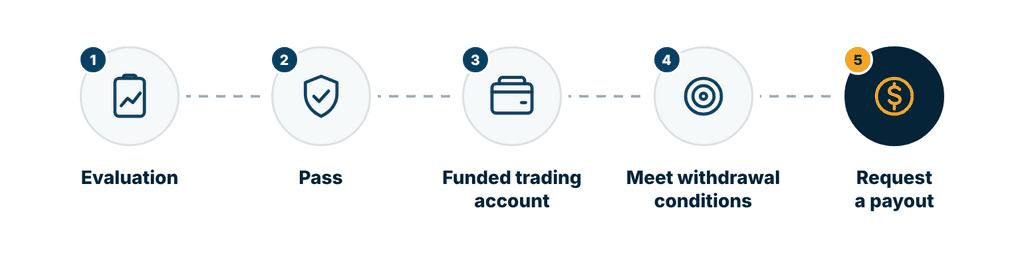
- Choose an evaluation: You select a program, account size, and fee structure. Some firms charge a recurring subscription, while others charge a one-time evaluation fee.
- Trade under the firm’s rules: You normally receive access to a virtual account balance* and live or delayed market data, depending on the provider. Some rules you might have to follow during the evaluation include a profit target, drawdown limit, daily loss limit, position-size restriction, trading hours, and other requirements.
- Pass the evaluation: Reaching the profit target is usually only part of the job. You must also stay within the firm’s risk limits because breaching a rule such as the drawdown limit can result in immediate failure. Some evaluations may also include additional requirements, such as a consistency rule, that must be met before you can pass.
- Transition to a funded trading account: The firm verifies your performance and provides access to the next account. Depending on the provider, that account may be a live brokerage account or remain simulated.
- Qualify for withdrawals: This is where the fine print matters most. Some firms require a certain number of profitable trading days, a profit buffer, a consistency test, or a combination of these.
- Request and receive a payout: The firm pays the trader according to its withdrawal policy, after any applicable split (e.g., 80/20), fees, and other conditions. Some firms also set minimum and maximum amounts per withdrawal. A payout isn’t necessarily the same thing as withdrawing the entire profit shown on the screen.
The rules that decide whether you pass or fail
Most funded trading accounts revolve around a handful of rules, although the details vary considerably from one provider to another. The most common ones include:
- Profit target
That’s the profit you need to make to complete the evaluation, and it may be a fixed dollar amount or a percentage of the starting balance.
- Drawdown
It sets the minimum allowed account balance* you can reach, and dipping below it would fail your evaluation. There are different types of drawdowns.
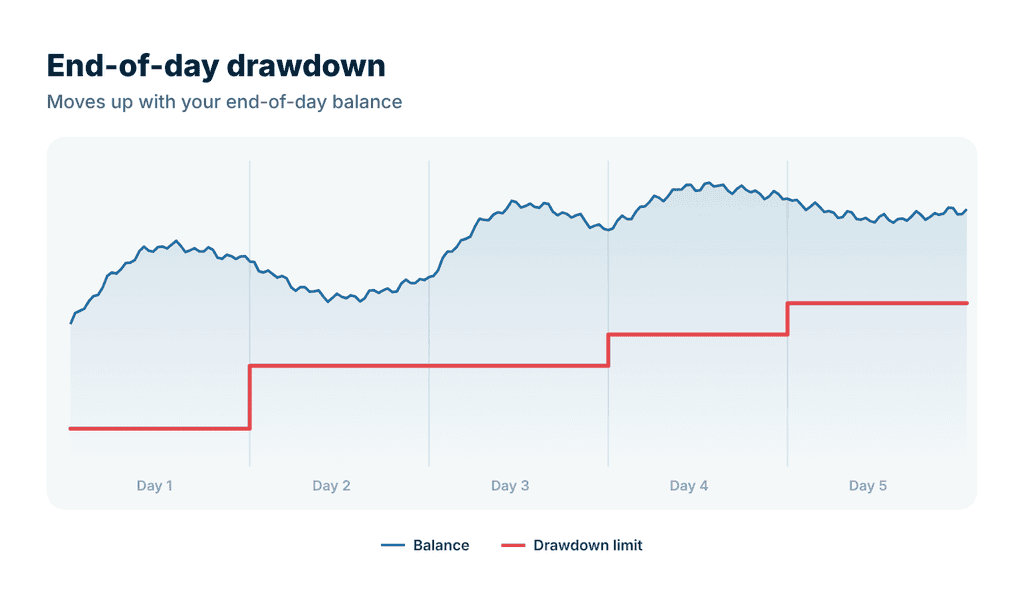
With the end-of-day drawdown (EOD), for example, the threshold is generally calculated using the end-of-day balance. It is pegged to positive account performance and adjusts upward as your profit increases.
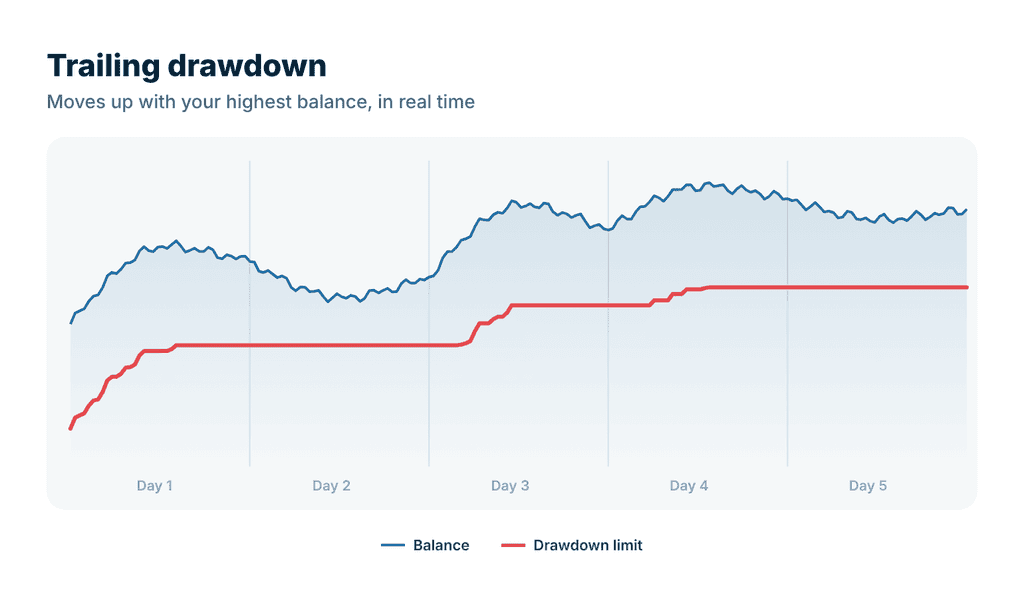
A trailing drawdown can move upward as the account makes money, sometimes using unrealized gains in the calculation. It increases dollar-for-dollar with your positive account performance during the trading day.
A static or fixed drawdown is just that – it doesn’t move once established.
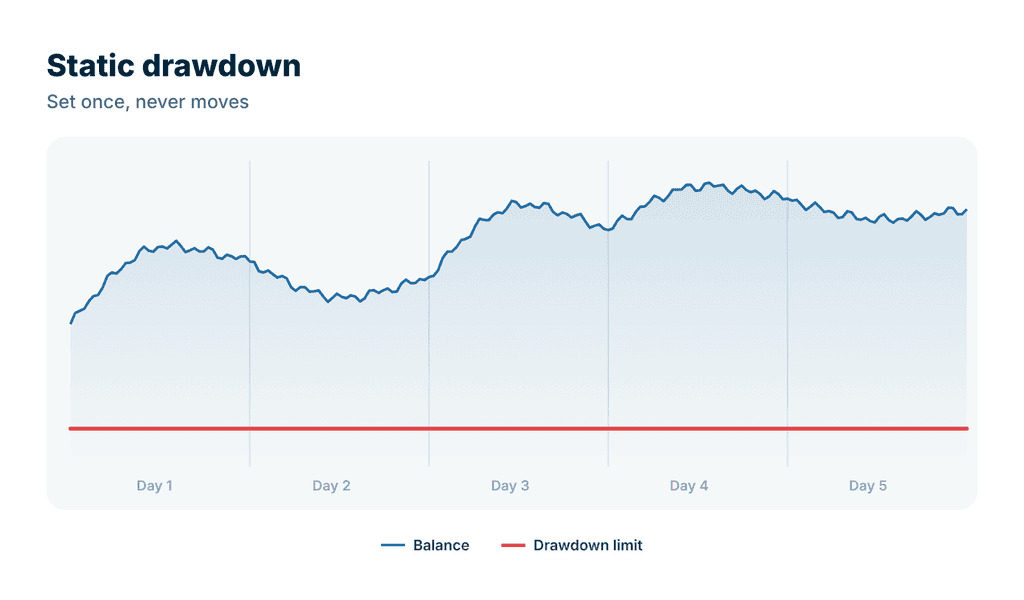
The type of drawdown used can determine how much room you actually have during a trade. See our drawdown guide for a detailed explanation.
- Daily loss limit
It restricts how much you can lose in one trading day. Some firms treat this as an automatic trigger for account failure, while others make you stop trading for the day and allow the evaluation to continue.
- Consistency rule
It limits how much of your total profit can come from one trading day (e.g., 30%). The idea is to eliminate the element of luck and the weight that one-off wins carry in your overall performance. In other words, it aims to ensure you demonstrate consistent results.
While the rule universally prevents you from reaching the profit target through one unusually large trade and little else, its exact formulation might differ across firms.
- Contract limits
The limits (e.g., 5 mini contracts, 50 micro contracts, etc.) restrict how many contracts you can trade for your particular account. For example, a trader might be allowed to trade fewer contracts with smaller accounts (e.g., 2 minis for $25K* accounts) and more contracts at the higher tiers (e.g., 15 minis for $200K* accounts).
- Trading-hour or news trading rules
Some programs prohibit overnight positions, restrict trading around market closures, or specify when you must close all positions and working orders.
Some companies even prohibit you from trading around news events.
How prop trading firms make money
The industry’s business model is fairly straightforward. A trader pays to enter an evaluation – if they fail, they may purchase another evaluation or reset the existing one. If they haven’t reached the profit target by the next billing date, the subscription renews, and they can continue the evaluation. If they pass, the firm shares profits with them under the funded trading account’s terms.
That means evaluation fees, recurring subscriptions, and resets are an important part of the industry’s economics. So, in that sense, a firm doesn’t need every customer to become a long-term profitable trader for their business to work.
Parts of these profits are used to cover the high costs prop trading firms face, including technology, market data, brokerage, compliance, and operations. On top of these are the payouts generated by successful traders.
The main types of evaluations in funded trading programs
There are over 60 prop trading firms operating as of the time of writing, each of which offers a variety of evaluations and funded trading programs. As a result, it can be challenging to find the right fit. To make things easier for you, we’ve listed the most popular types of evaluations and their specifics:
| Structure | What it means | What to watch |
| One-step evaluation | One set of rules must be completed before funding. | The evaluation can look simple, but the risk rules may be tight. |
| Two-step evaluation | The trader must pass two separate stages. | A lower first target doesn’t necessarily mean an easier route to withdrawals. |
| Subscription | The evaluation renews periodically until it is passed or canceled. | Time spent in the evaluation can increase the total cost. |
| One-time fee | The evaluation is purchased once. | Failing means paying for another attempt. |
| End-of-day drawdown | Calculated using end-of-day account performance. | Intraday movement may be treated differently from a trailing model. |
| Intraday trailing drawdown | The loss threshold can move with account performance during the trading session. | Open profits can change the amount of room available. |
| Static/fixed drawdown | The minimum balance remains locked in. | Easier to calculate, but the starting cushion may be smaller. |
| Scaling contract limits | Increases your contract limits in stages as your account balance* grows. | The maximum number of contracts shown for your account size may not be available from the start – it can increase gradually as your account balance grows. |
There is no universally “best” structure here. A trader who dislikes recurring fees may prefer a one-time evaluation, and someone who trades cautiously may prefer a drawdown model they can calculate easily. Another trader may care more about how quickly profits become eligible for withdrawal. So the important comparison happens after you pass the evaluation phase.

How it works at Earn2Trade: Stages, rules and payouts
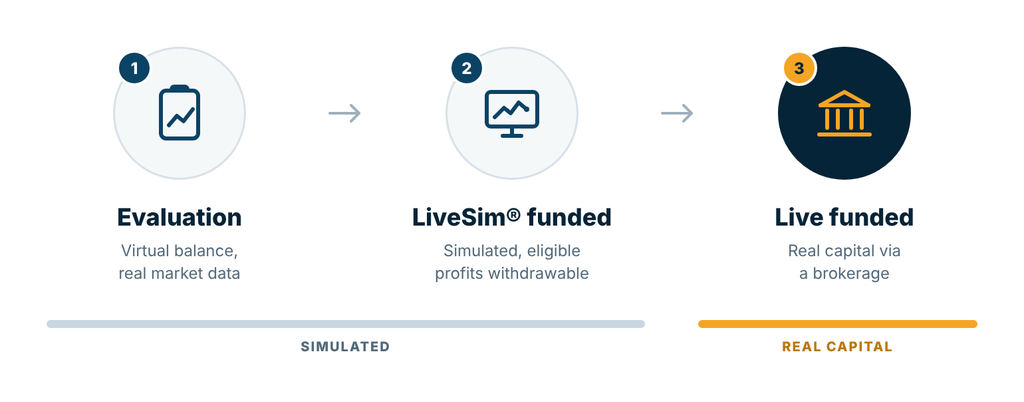
At Earn2Trade, a trader’s journey has three distinct stages, starting with the evaluation, where you trade a virtual account balance* using real market data. After passing, you can receive a LiveSim® funded trading account, which remains simulated but uses real-time market data and allows eligible profits to be withdrawn. The third option is a Live funded trading account, where you trade with real capital through a brokerage arrangement.
For a concrete example, take the current TCP25 evaluation of the Trader Career Path® program. You start with a $25,000 balance*, a $1,750 profit target, a $1,500 end-of-day drawdown, a $550 daily loss limit, and a 2-contract limit. The drawdown stops moving once it reaches the starting balance.
The evaluation also has a 30% consistency rule. In other words, no single trading day can account for more than 30% of your total profit during the evaluation. Suppose the target is $1,750 and you make $700 on one day, which equals 40% of the original target. While you haven’t failed your evaluation, you need to keep trading until your total profit is high enough that the $700 day represents no more than 30% of the eventual total. In that particular case, total profit must exceed $2,333 to pass the evaluation. The rule disappears once you move into a LiveSim® or Live funded trading account.
There is no minimum number of trading days in the evaluation, but the 30% consistency requirement means a trader needs at least four profitable trading days to complete the evaluation, provided all other requirements are met. Once funded, you can request a withdrawal after five qualifying trading days (not necessarily consecutive).

Approved trading times
At Earn2Trade, you are allowed to trade around news events.
Positions and working orders must be closed by 3:50 p.m. Central Time, and overnight positions are prohibited. Furthermore, some futures contracts have earlier session-specific cutoffs, so the general 3:50 p.m. CT rule shouldn’t be treated as the only relevant closing time.
That restriction is easy to overlook if you normally trade a strategy that carries positions through the evening session, so it needs to be part of the strategy from the beginning rather than something you remember five minutes before the cutoff.

Contract limits
Each Earn2Trade evaluation has a fixed maximum number of contracts you can trade at once. This limit applies to the total number of contracts across all open positions. Ten micro contracts count as one contract toward your limit.
Contract limits are enforced directly at the system level, meaning you cannot open positions that exceed your allowed limit. Attempting to exceed the contract limit does not fail your evaluation – the system simply prevents the order from going through.

Payouts and costs
At Earn2Trade, funded trading accounts have no subscription fee. There are also no funded-stage consistency or profit-buffer requirements to meet before a withdrawal, but you need to complete five qualifying trading days before each withdrawal request. Withdrawals are processed weekly, with a $100 minimum net withdrawal after the applicable profit split and fees. Requests need to be submitted by 2:00 p.m. CT on the Friday before they are processed on the following Wednesday.
The profit split depends on the size of the individual withdrawal, not the account’s total profit. For example, the current Gauntlet Mini™ GAU50 structure uses a 50/50 split for withdrawals below $2,250 and an 80/20 split for withdrawals of $2,250 or more. The LiveSim® withdrawal cap for GAU50 is $5,000 (a cumulative total you can withdraw on LiveSim®, after which the account moves to Live). You can check out the complete withdrawal policy details here.
Regarding account costs, non-professional traders at Earn2Trade don’t pay out-of-pocket market-data fees during the evaluation. For a non-professional LiveSim® funded trading account, a one-time $139 activation fee is deducted from the first profitable withdrawal rather than charged upfront (no withdrawal means no activation fee owed).
Professional traders have different market-data charges. Live trading also carries market-data costs, with current published rates of $140 per month per exchange for Rithmic users and $156 per month per exchange for NinjaTrader Live users.
Any applicable fees and commissions per trade are deducted from your funded trading account balance.
Payout timing, minimums, splits, and fees are subject to the applicable withdrawal policy and can change. A withdrawal request is not a guarantee of payment.
Why most traders don’t pass
As per Earn2Trade’s Exam Disclaimer, the evaluation pass rate in 2025 was 8.89%. Internal data from more than 15,000 failed accounts reveals that most failures (90%) resulted from breaching risk limits rather than failing to reach the profit target. More specifically, 56% were tied to the drawdown limit and 34% to the daily loss limit.
At Earn2Trade, 8.89% of new subscriptions resulted in a passed evaluation in 2025 (Earn2Trade Exam Disclaimer).
15,000+ failed accounts: 56% due to drawdown limit, 34% due to daily loss limit (Earn2Trade internal data).
The published 8.89% figure is calculated as subscriptions passed divided by new subscriptions, so it shouldn’t be interpreted as the probability that an individual trader will pass on a single attempt. Among candidates who passed an examination or progressed through the Trader Career Path®, 94.77% traded a LiveSim® funded trading account, and 5.23% traded a Live funded trading account in 2025.
These figures are enough of a reason to keep expectations grounded. The Commodity Futures Trading Commission (CFTC) describes futures trading as volatile, complex, and risky, and warns that losses can exceed the amount initially invested when trading futures directly. The NFA similarly advises trading futures only with risk capital and warns that leverage can make profit-and-loss fluctuations much larger.
While the evaluation of a funded trading program can’t make futures themselves less volatile, it can help you master the risk management skills needed to avoid the most common reasons for account failure and position you for a successful trading career.
Who are funded trading accounts actually for?
First and foremost, they are a great fit for those who want to find out whether they are cut out for a professional trading career by learning the trade independently and then proving their skills and discipline in a prop trading firm’s challenge. They’re also suitable for those who want to kickstart their trading journey with minimal upfront costs (in the best-case scenario, it can be just the cost of the evaluation or the subscription before they gain access to a funded trading account).
Funded trading accounts can make sense for traders who already have a defined strategy and want to test it in a controlled environment with clear rules. They can also suit someone who wants to learn how their execution behaves when a daily loss limit or drawdown threshold is always sitting in the background.
On the other hand, they are a poor fit for someone who is still trying to discover whether they can trade with discipline at all. Paying for repeated evaluations while changing strategies every few days can become an expensive way to learn a lesson you could have learned in a simulator first.
Whether funded trading programs are one’s cup of tea is also a matter of trading style. A trader can be perfectly capable of finding profitable setups and still be poorly suited to a particular evaluation because its rules conflict with how they trade. Someone who relies on overnight positions, for example, needs a program that permits them, while someone who routinely makes one large trade a day needs to pay close attention to consistency rules.
FAQ
Sometimes. Many programs use a virtual account balance* even after a trader passes an evaluation, while others provide access to a live brokerage account. At Earn2Trade, a LiveSim® funded trading account remains simulated, while a Live funded trading account trades with real capital.
Usually, you pay to enter the evaluation, though pricing models vary by provider. The initial fee may be a one-time charge, a recurring subscription, or accompanied by reset costs. At Earn2Trade, there is no subscription fee once you become funded, although applicable data and activation costs can still apply.
Some evaluations can technically be completed in a single trading day. At Earn2Trade, there is no formal minimum number of evaluation days, but the 30% consistency rule means the current evaluation requires at least four profitable trading days.
It depends on the program’s terms. A funded trader generally doesn’t put up any of the firm’s headline account balance as their own capital or become personally liable for trading losses. However, they can lose the evaluation fee and other program costs they have paid, such as subscription, reset, or data fees. Futures trading itself carries much greater financial risk when you use your own real capital, which is why regulators advise understanding the risks and using only money you can afford to lose.
Usually, the account is failed or closed, although the consequence depends on the particular rule and provider. At Earn2Trade, breaching the evaluation’s daily loss limit, falling below the minimum balance, or trading outside approved hours ends the evaluation.
Funded trading accounts remain subject to their applicable risk rules as well. For example, with Earn2Trade, once funded, the daily loss limit, drawdown, contract limit (enforced by the platform), and approved times still apply. Furthermore, five unscheduled consecutive trading days without a trade lead to a closure of the funded trading account.
There are legitimate firms operating funded trading programs, but a “funded trading account” isn’t a guarantee of a particular structure or level of regulatory protection. Before paying, check who provides the account, whether trading is simulated or live, how withdrawals work, what happens if you breach a rule, and what fees they can charge after you pass. The CFTC specifically recommends reviewing risk disclosures and gathering information before entering futures-related arrangements.
Don’t focus on the headline account balance. Once you understand how the evaluation, drawdown, position limits, and withdrawals fit together, you can judge a funded trading account by what actually determines your experience: the rules you have to live with after you buy it.
*At Earn2Trade, evaluation and LiveSim® account balances are virtual; Live accounts use real capital.