
A prop firm (proprietary trading firm) lets traders trade its capital or virtual account balance in exchange for a share of the profits. Most modern prop firms offer evaluation-based programs – you pay to prove you can follow their rules, and if you pass the challenge, you’re funded. However, most traders don’t pass.
Prop trading firms and evaluation programs vary widely, with rules, fees, and payout requirements differing by provider. Over the years, prop firms have become an alternative route into trading for people who want to demonstrate their skills without risking a large amount of personal capital in their own brokerage account.
This guide dives into everything you need to know about prop firms, including:
What is a prop firm?
Proprietary simply means something belongs to the company – in this case, the capital. A prop firm lets traders who have passed an evaluation access a funded trading account with real capital or a virtual account balance. Account holders can then start trading and retain a share of the profits they make (e.g., 50% or 80%).
In traditional proprietary trading, a firm uses its own money to trade financial instruments. Traders may work at the firm’s office, use its technology and risk-management systems, and operate under limits set by the trading desk. Their job is to make trading decisions within those limits, and the firm takes on the financial results.
Rather than hiring traders as employees to trade company capital from day one, modern online prop trading firms invite people to complete a paid evaluation. To do so, they have to meet a profit target without breaking rules such as maximum drawdown (the amount an account is allowed to lose under the firm’s rules before the trading attempt or account is stopped) or daily loss limits (how much you can lose during a single trading day before the evaluation fails).
Passing it then qualifies the trader for a funded trading account. However, the definition of a funded trading account can vary between service providers (learn more in our dedicated article). For example, some firms provide a simulated account with a virtual balance and pay eligible traders under a contractual arrangement. Others may move traders to an account where orders are executed in live markets using real capital.
Prop firms can offer an alternative to trading a personal brokerage account, particularly for traders who don’t have much capital of their own. In return, they bring another set of constraints, such as entry fees, performance requirements, trading rules, and conditions that determine whether a payout is approved.
Key takeaway: A prop firm offers a way to trade under its program rules, but understand whether the account is simulated or live, what you can actually risk, and what you must do to qualify for payment.

How do prop firms make money?
Traditional proprietary trading firms aim to make money from trading activity using their own capital.
Evaluation-based online firms may also earn money from trading-related activity, but mostly rely on fees (e.g., one-time evaluation fees, monthly subscriptions, etc.) from users who want to qualify for funded trading accounts. If the attempt fails, the trader may need to buy a reset, pay for another evaluation, or keep paying the subscription to try again, depending on the program. As a result, a trader who spends several months attempting an evaluation may pay substantially more than someone who passes quickly. Furthermore, reset fees, activation charges after passing, and market data fees can also add to the bill.
Firms also share a predetermined percentage of the profits with eligible traders and keep the rest, providing another possible revenue source for the business beyond fees. The split may change after a certain payout amount or as the trader advances through a program.
So, when choosing a prop firm, consider whether the provider publishes a transparent fee policy, explains how traders qualify for payouts, and keeps its rules easy to understand. If the answers are vague, or if the business relies on dramatic claims about how easy it is to pass, be cautious. Importantly, bear in mind that a legit prop trading firm won’t change its rules for existing customers and force them to adhere to requirements that weren’t in place when they first signed up.
Key takeaway: Evaluation fees and subscriptions are a major part of the modern prop firm revenue stream. Make sure to calculate the cost of multiple attempts, and not just the advertised starting price.

The different types of prop firms
Prop firms usually differ in various aspects, including the markets they offer, how traders qualify, and how they charge for access, to name a few. As a result, two companies may both call themselves prop firms while giving traders very different experiences.
The table below outlines common industry models. Note that individual firms may also combine features from more than one category.
| Model | How it works | What to check |
| Futures prop firm | Offers access to futures markets, where standardized contracts let traders speculate on or hedge the future price of an asset. | Contract limits, trading hours, daily loss rules, data fees, and whether trading is simulated or live. |
| Forex prop firm | Focuses on foreign exchange, the market for trading currency pairs such as EUR/USD. | Spread and commission assumptions, leverage, overnight charges, restricted strategies, and payout conditions. |
| Crypto prop firm | Offers programs linked to cryptocurrencies, such as Bitcoin or Ether. | Which products are available, how prices are formed, volatility limits, fees, and whether positions are simulated or live. |
| One-step evaluation | Requires a trader to meet the program’s performance conditions in a single evaluation stage. | Profit target, drawdown, time limits, and what happens after passing. |
| Two-step evaluation | Requires the trader to pass two separate stages, often with different targets or risk rules. | Requirements for each stage, whether fees apply to both, and the conditions for receiving a funded trading account. |
| Subscription model | Charges a recurring fee, commonly monthly, while the trader uses or attempts the program. | Renewal dates, cancellation terms, reset costs, and whether the subscription continues after passing. |
| One-time fee model | Charges a single upfront fee for an evaluation or program access. | What’s included, whether another fee is due after passing, and the cost of additional attempts. |
| Instant funding | Offers access to a trading program without the usual evaluation process. | Higher upfront costs, tighter loss limits, payout restrictions, and any other conditions that replace the evaluation. |
Key takeaway: Compare the complete program with all of its rules. Market access, evaluation stages, recurring fees, and post-passing conditions all affect whether a prop firm’s offering fits your trading style and goals.
The rules prop trading firms use
A prop firm’s rules determine everything from how you must trade and when you can lose access to an account, to whether you qualify for a payout and when you can withdraw money.
For example, the profit target is the amount you must earn during an evaluation to meet its profit requirement.
A drawdown limit defines how much the account balance can fall as per the firm’s chosen calculation method. Some firms track drawdown throughout the session; others update it at the end of the trading day, and some use a fixed threshold (for a closer look at the differences between intraday trailing, end-of-day and static limits, see our dedicated drawdown guide).
A daily loss limit caps the loss allowed during a trading day, and breaching it may end the attempt even if the account remains above its overall drawdown threshold.
A consistency rule mandates how much of your total profit can come from a single day or trade, depending on the firm’s exact rule formulation. It is intended to discourage a trader from meeting a target through one unusually large result, but it can also affect how quickly you can qualify.
There are other rules as well. For example, some govern how many contracts you may trade, while others set limits on when trading is allowed and how long you can leave an account inactive (e.g., some firms may require you to close positions by a specified time or prohibit holding trades overnight). Some programs also impose minimum trading-day requirements.
Key takeaway: Profit targets tell you what you need to achieve; drawdown and daily loss limits define what you can’t afford to lose; and consistency mandates how much total profit can come from a single day. Trading hours and contract limits indicate how many contracts you can trade and when. Read the rules together, because one limit can end an attempt even if another hasn’t been breached.
How payouts work across firms
Passing an evaluation isn’t the same as withdrawing your hard-earned profits. To explain how payouts work across prop trading firms, we should start by distinguishing between a simulated account and a live trading account.
In a simulated environment, trades are placed in a system that imitates market trading, but the orders don’t necessarily represent real-money transactions. The balance displayed there is a virtual account balance and not a cash deposit available for withdrawal. However, a firm may still pay eligible traders under its program terms.
In a live account, on the other hand, orders are executed in the market, and the firm has real capital exposed to real-world trading outcomes.
Profit splits are another important detail. A firm usually pays the trader a percentage of eligible profits and retains the remainder. The percentage can be fixed or tiered, with the split changing after a specified threshold. Check when the split applies, whether it changes over time, and whether the terms distinguish between simulated and live trading.
Some firms also cap the amount a trader can withdraw at once. Once a trader reaches the cap, they may become subject to a different set of rules. Some programs also limit the number or size of withdrawals, require a minimum amount before you can request payment, or impose conditions related to consistency and trading activity.
We should also say a few words about what a qualifying trading day is. A qualifying trading day is a day that counts toward a firm’s payout requirements. Some programs require a minimum number of these days before you can submit a withdrawal request, while others allow a request once the trader meets the applicable profit and account conditions.
Payout disclaimer: Payout timing, eligibility, caps, profit splits, and fees depend on the specific program and its rules. Meeting a stated timeline or submitting a request doesn’t guarantee payout approval or payment. Confirm the applicable terms with the firm before purchasing or requesting a withdrawal.
Key takeaway: Passing the evaluation is an important milestone, but it isn’t a guarantee of a payout. Check the account type, split, caps, fees, and withdrawal conditions before you subscribe or purchase a program.
How to choose a prop firm
Prop trading firms have various ways to appeal to prospective traders – be it advertising huge discounts, highlighting a payout percentage on their landing pages, or focusing specifically on the huge account balances that they will let you manage. However, what’s most important and often lacking from a sales page is how a firm behaves when business conditions change, or a trader disputes a decision, for example.
So, to make sure you will find a reliable service provider to accompany you on your journey to a professional trading career, start with the following questions:
- How long has the firm been in business and what’s its reputation? Time in the market doesn’t guarantee reliability, but a longer track record gives you more history to investigate. Look for evidence of continued operations, transparent client communication, clear policies, and a consistent public presence, rather than relying only on testimonials.
- Has it ever changed rules retroactively? Firms may update programs, prices, or terms for new customers, which is completely normal. However, it’s concerning if a firm changes the rules after a trader has already purchased an evaluation or qualified under earlier terms. Ask which version applies to your account and keep a copy.
- How did it treat traders when things went wrong? Look beyond success stories – search for reports about delayed or denied payouts, account closures, technical issues, and how disputes or user-reported issues were handled. One complaint doesn’t tell the whole story, but repeated, similar complaints deserve attention. Look specifically for whether the firm explains its decisions and provides a workable process for resolving disagreements.
Watch the video below for a discussion of these questions and why a firm’s track record matters when choosing a futures prop firm.

There are other warning signs and red flags worth investigating as well. Rapid growth isn’t automatically a problem, but a firm expanding faster than it can support its operations may struggle when payout volumes, customer support needs, or market conditions change. Country restrictions can also matter, so check whether you are eligible to join before paying, and whether the firm can continue serving you if your residence changes.
Look carefully at inactivity rules. A short window can put pressure on traders who take breaks, travel, or trade only when their setups appear. Understand what happens if you reach a live account, too. A transition to live trading should be explained clearly and shouldn’t come as a surprise that changes the account conditions or ends access to a program you thought you were continuing.
Finally, verify the firm and its claims through sources outside its own marketing. The U.S. Commodity Futures Trading Commission offers a registration and background-check resource, while the National Futures Association explains how to conduct due diligence on financial firms. These resources are useful starting points, but they aren’t a universal approval list for every business calling itself a prop firm. Regulatory requirements depend on the firm’s activities, products, and jurisdictions, and some firms may operate under different arrangements or exemptions.
Key takeaway: Choose a prop firm by examining its track record, rule change practices, and response to disputes – not by the size of its discount or the payout percentage on its homepage.
Are prop firms legit?
There are many legitimate prop firms, but the industry also has its “bad apples.” At the end of the day, it’s up to you to examine the specific firm’s business model, contract, rules, and history.
Be wary of claims that suggest passing is easy or payouts are guaranteed. A legitimate business can still offer a program with rules or costs that might deceive you, and an attractive marketing page isn’t proof that a firm will handle every dispute fairly.
Key takeaway: Don’t judge every prop firm as legitimate or illegitimate based on the category. Assess each company and its terms on their own merits.
How it works at Earn2Trade
At Earn2Trade, we have been specializing in futures trading since 2016. Both of our programs, the Trader Career Path® and Gauntlet Mini™, use an evaluation process but differ in how traders progress and which account sizes are available as they advance.
During the evaluation period, you trade under the program’s rules and must meet its profit target and comply with trading and risk requirements, such as drawdown, daily loss limits, and other applicable rules (e.g., consistency, trading hours, contract limits, etc.). At Earn2Trade, the evaluation has no time limit, so you don’t have to finish within a fixed number of calendar days.
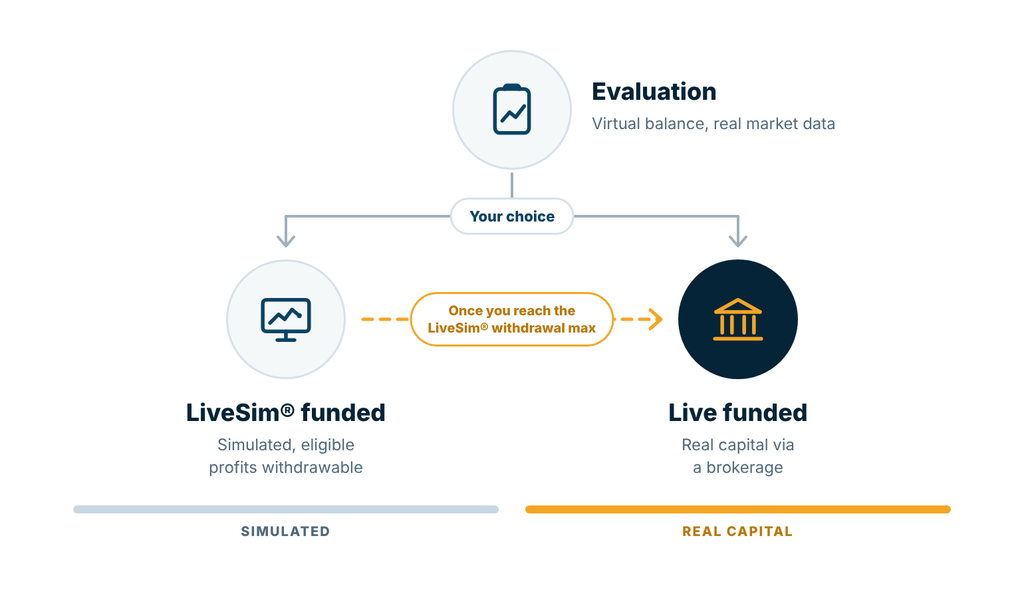
After you pass the evaluation and complete the required steps, you can choose between a LiveSim® funded trading account and a Live account. LiveSim® is still a simulated environment, and its balance is virtual, but the profits you earn can be withdrawn as payouts under the program’s terms.
Only a Live account trades real money in the market. If you start on LiveSim®, you transition to a Live account once you reach the program’s maximum LiveSim® withdrawal amount, subject to the applicable requirements. Because a Live account involves real-money market execution, its conditions are different from those of a simulated account.
You can review the current program details on our homepage and the dedicated Trader Career Path® and Gauntlet Mini™ pages before choosing an evaluation.
Key takeaway: At Earn2Trade, the route is yours to choose: Evaluation → your choice of a LiveSim® or Live funded trading account → if you start on LiveSim®, Live trading once you reach the LiveSim® withdrawal maximum. Know which stage you are entering and what changes at the next one.
Where Earn2Trade is strong
Earn2Trade evaluations don’t have a time limit, which can help if you trade selectively, have a job alongside trading, or prefer to wait for setups that fit your strategy rather than trading just to comply with a deadline. As a result, you aren’t required to manufacture activity just to beat a calendar.
At Earn2Trade, the minimum withdrawal request starts at just $100 net (a request doesn’t guarantee approval or payment). Check the current program terms for the fees, profit split, and other requirements that apply to your account.
Furthermore, Earn2Trade accepts traders from more jurisdictions than most competitors, including Morocco, Algeria, Tunisia, Lebanon, and Turkey. Country lists can change, so traders should verify theirs is supported before purchasing an evaluation, especially if they live in or plan to move to a country with different restrictions.
Earn2Trade’s Trader Career Path® offers a progression model that can scale to a $400,000* account size at its top tiers, one of the highest in the industry. The advertised balance isn’t the same as the amount a trader can lose or withdraw, and the applicable drawdown and other program limits determine the account’s practical risk allowance.
Furthermore, we don’t believe that there is a universally best program for each trader. Instead, the right fit depends on your market experience, the risk limits you can work within, the amount you are willing to spend on an evaluation, and whether you understand the path from simulation to live trading. Read the current terms before deciding.
Key takeaway: At Earn2Trade, the evaluation has no time limit, the minimum withdrawal request starts at $100 net, and Trader Career Path® can scale to $400,000* at the top tiers. Eligibility and payout conditions still apply.
Our trade-offs and requirements, stated honestly
Earn2Trade’s evaluations use a monthly subscription model rather than a one-time fee. That makes it important to consider how long you may need to work on the evaluation since recurring fees can add up if you take several attempts or need more time to develop a strategy. Check the current price and cancellation terms, and calculate what multiple months would cost before you start.
At Earn2Trade, breaching the daily loss limit ends the trading attempt. That rule is separate from the overall drawdown limit, so a trader can fail an evaluation by hitting the daily limit even if the account hasn’t reached its maximum overall drawdown. If your strategy relies on large intraday swings, you need to understand how the daily limit interacts with your usual position size and stop-loss approach.

Earn2Trade’s evaluations also include a 30% consistency rule. In simple terms, no single trading day can account for more than 30% of the total profit used to meet the evaluation target. For example, with a $1,750 target, a day with more than $525 in profit would exceed 30% of that target. As a result, a trader who reaches the target through one unusually strong day may need to continue trading until the results meet the consistency requirement. This rule applies during the evaluation and doesn’t apply during the funded stage.

At Earn2Trade, funded trading accounts also have a five-trading-day inactivity rule. Traders who stop trading for too long can risk losing access, so keep this in mind if you expect extended breaks or trade only occasionally.
Our profit split is tiered and depends on the applicable program and withdrawal amount. For example, the Gauntlet Mini™ $50,000* program uses a 50/50 split for withdrawals below $2,250 and an 80/20 split at $2,250 or more. Check the current terms before purchasing, since program details and promotions can change.
Making a withdrawal request also requires five qualifying trading days (not necessarily consecutive). All onboarding paperwork must be completed before any withdrawal is processed.
Payout disclaimer: Payout timing, eligibility, caps, profit splits, and fees depend on the specific program and its rules. Meeting a stated timeline or submitting a request doesn’t guarantee payout approval or payment. Confirm the applicable terms with Earn2Trade before purchasing or requesting a withdrawal.
Key takeaway: Earn2Trade’s rules offer a clear structure and no retrospective changes, but the subscription fee, daily loss limit, evaluation consistency requirement, and funded-stage inactivity rule might not suit every trading style. Decide whether you can work within them before starting.
Is a prop firm right for you?
A prop firm may be worth considering if you have an established trading approach, understand the market you want to trade, and can follow risk rules consistently. It may also appeal to someone who wants to demonstrate their skills without putting a large amount of personal trading capital into a brokerage account. But an evaluation isn’t a shortcut around learning how markets work, and you still need a strategy, a realistic understanding of risk, and the discipline to stop when the rules require it.
It is a poorer fit if you need to make money quickly, would have to borrow to pay the evaluation fee, or plan to trade in a way that conflicts with the firm’s limits. If you are still changing strategies every few days, consider practicing in a simulator first. CME Group’s futures education resources explain contract mechanics, margin, and settlement, and can help beginners understand what they are trading before paying for a prop firm evaluation. Futures trading can involve substantial risk, and leverage can magnify losses as well as gains.
Before you join any firm, work through the numbers. What will the evaluation cost if it takes two or three attempts? What is the drawdown allowance relative to your typical losing streak? Can you trade within the daily loss limit without changing your strategy too much? Do you understand the payout terms and whether the account is simulated or live? If you can’t answer those and other relevant questions, take more time to research.
The decision shouldn’t come down to the largest advertised account or the most generous headline split and shouldn’t be rushed. Instead, choose a program whose rules you understand and whose costs you can afford to lose, and do so carefully and only after you are convinced and have enough data to make an informed decision. And don’t forget that, at the end of the day, even a good fit doesn’t guarantee you will pass an evaluation or receive a payout.
*At Earn2Trade, evaluation and LiveSim® account balances are virtual; Live accounts use real capital.
Frequently asked questions
Not necessarily. Many evaluation-based firms start traders in a simulated environment, where the displayed balance is a virtual account balance, and pay eligible traders under the program’s terms, while others provide a route to live trading. Check what kind of account you receive and what conditions apply before you pay.
Costs range from one-time evaluation fees to recurring subscriptions, and the total can increase if you need resets or additional attempts. Some programs also charge activation or market data fees after you pass, so compare the full cost, not just the promotional entry price. At Earn2Trade, evaluations use a monthly subscription model, and current pricing depends on the program and any applicable promotion.
A broker provides access to financial markets and executes trades on behalf of clients or other market participants. A prop firm offers a trading program or arrangement under which a trader can qualify to trade under the firm’s rules. Depending on the program, this may involve simulated trading before transitioning to live markets.
No. Prop firms may restrict access based on a trader’s country of residence, applicable laws, payment availability, or other eligibility requirements. Check the firm’s current country list before purchasing an evaluation, and confirm what happens if you relocate after enrolling.
Pass rates vary by firm, program, period, and the way results are calculated, so be cautious about comparisons that don’t explain their methodology. Make sure to ask the prop firm whether a published figure counts unique traders, evaluation attempts, or subscriptions, since those measures can skew the results. Request complete and verified information. At Earn2Trade, 8.89% of new subscriptions resulted in a passed evaluation in 2025 (Earn2Trade Exam Disclaimer), for example.
Neither option is automatically better. A prop firm may offer a structured evaluation and a defined risk framework, but it also imposes rules and fees. Trading your own brokerage account gives you more direct control over your capital but means you bear the trading losses yourself. The right choice depends on your experience, capital, strategy, and ability to follow rules.
Before you start: Read the program rules, calculate the full cost of trying to qualify, and make sure you understand how the firm handles drawdown, account transitions, and payouts. Judge a prop firm by its actual terms and track record, not its advertised account size alone.