
Drawdown is the maximum amount an evaluation or funded trading account can lose before the account fails. There are different types of drawdowns. An intraday trailing drawdown, for example, is a dynamic risk-management rule that moves up as your account reaches new highs during the trading session. A static drawdown, on the other hand, keeps your maximum allowable loss fixed at a certain level and never moves. A trailing end-of-day (EOD) drawdown updates based on your closing balance.
The drawdown is among the most important rules determining whether one can keep trading or their attempt ends. In fact, Earn2Trade internal data from more than 15,000 failed accounts shows that the drawdown and daily loss limit together account for over 90% of recorded failures.
However, drawdown is just one of a number of rules that prop firms have in place, and understanding how they work and how to stay compliant is critical for one’s funded trading performance. This guide covers everything you need to know about drawdown, daily loss limits, consistency, and other common rules across the prop trading industry.
What is drawdown in trading?
In trading, drawdown describes a decline in equity, account balance, or asset price from a previous high to a subsequent low. It measures the drop from peak to trough in dollars or as a percentage. For example, if an account rises to $26,000* and later falls to $24,800*, the drawdown from the peak is $1,200. When measured in percentages, a 20% drawdown would require a 25% gain to recover.
Drawdown doesn’t always reflect a realized loss but can also measure temporary capital erosion. It is an important risk-assessment metric that can estimate the aggressiveness of a trading strategy, and an invaluable trading psychology tool, since severe drawdowns can put a trader’s discipline to the test.
Prop trading firms use drawdowns in a very specific way. The drawdown in prop trading defines the maximum loss threshold you must stay above to keep an evaluation or funded trading account active. While many firms enforce strict max drawdown limits, the exact calculation depends on the program. Furthermore, two accounts with the same advertised balance can have very different practical risk limits because their drawdown rules work differently. What they have in common, though, is that violating these limits often results in immediate account termination.

The three types of prop firm drawdown
The most common prop firm drawdown types are intraday trailing, end-of-day trailing, and fixed/static. There is no universally best choice, as each offers different room for losses before you violate the rule.
| Drawdown type | How the floor moves | When it updates |
| Intraday trailing | Rises with new highs | During the session, according to the firm’s calculation |
| End-of-day trailing | Rises when the closing balance sets a new high | At the daily close |
| Static | Doesn’t move | Never – stays fixed |
The easiest way to understand the difference is to follow the same sequence of trading results under the three different drawdown types.
Intraday trailing drawdown
An intraday trailing drawdown is a dynamic risk limit that moves asymmetrically (always upward, never downward) as the account reaches new highs during the trading session. Depending on the firm’s exact calculation, this may include unrealized profits, meaning a position that moves into profit can raise the threshold even if you haven’t closed the trade.
So, with a $25,000* starting balance and a $1,500 drawdown, the initial floor is $23,500*. Assume the firm calculates the drawdown on open equity (the account balance plus any unrealized profit or loss). If account equity reaches $25,800*, the floor rises to $24,300*. If it later hits $26,500*, the floor rises to $25,000*. A subsequent decline can therefore bring equity close to its threshold even while the balance remains above the original starting amount. The table below follows account equity through a single trading session (figures and scenarios are illustrative). The floor follows the highest equity reached so far.
| Equity | What happens | Drawdown floor | |
| Start | $25,000* | The account’s starting point | $23,500* |
| Step 1 | $25,800* | New high: up $800 | $24,300* |
| Step 2 | $25,300* | Pullback of $500, no new high | $24,300* |
| Step 3 | $26,500* | New high: up $700 from the previous high | $25,000* |
| Step 4 | $25,100* | Pullback of $1,400, no new high | $25,000* |
The mechanics are simple – each time equity reaches a new intraday high, the floor moves up by the same amount as the new high rises above the previous one. If equity falls back, the floor stays where it is. Note that even a temporary increase in unrealized profit can push the floor higher. If the market then reverses, equity may fall to the floor and breach the limit before the trade is closed, even though the balance remains above its starting level.
Keep in mind that this example uses equity movements within a single session and the exact calculation depends on the firm’s rules, including how it treats intraday highs and unrealized profits. Make sure to always check whether the firm’s calculation follows closed-trade balance or real-time equity (including unrealized profit).
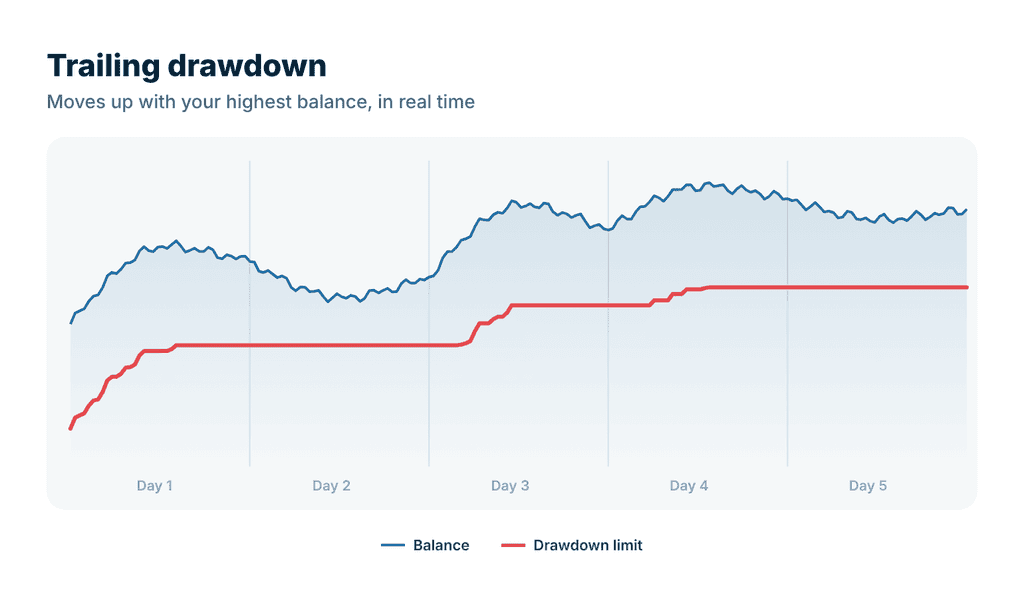
Intraday trailing drawdown may suit traders who closely monitor their positions and can manage risk in real time. It also tends to favor traders who take profits promptly, avoid large intraday swings, and keep enough distance between their current equity and the moving floor.
End-of-day trailing drawdown
An end-of-day trailing drawdown generally recalculates the threshold using the account’s balance at the close of the trading day. It still trails upward, but intraday highs don’t necessarily move the floor immediately (the exact cutoff and calculation can vary by provider).
The practical difference appears during the session. In the example above, the EOD floor would have stayed at $23,500* throughout the session, even after equity reached $26,500*. That can matter when a trade moves sharply in your favor and then reverses before the session ends. Here’s what would happen if those same figures were daily closes:
| Closing balance | Result | Drawdown floor | |
| Start | $25,000* | The account’s starting point | $23,500* |
| Day 1 | $25,800* | A gain of $800 | $24,300* |
| Day 2 | $25,300* | A loss of $500 | $24,300* |
| Day 3 | $26,500* | A gain of $1,200 | $25,000* |
| Day 4 | $25,100* | A loss of $1,400 | $25,000* |
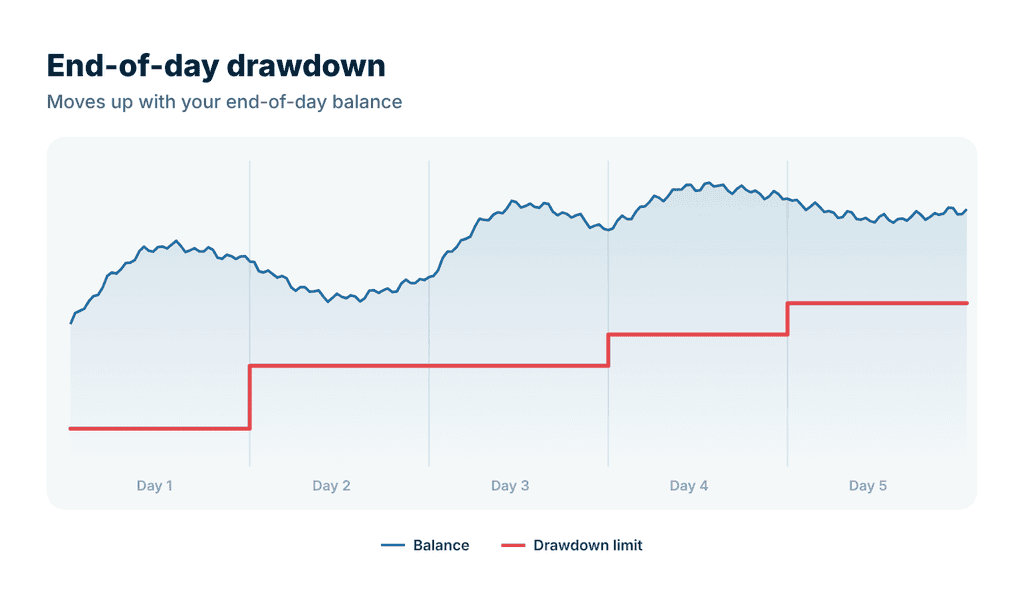
EOD trailing drawdown may suit traders whose positions swing temporarily during the session and who don’t want the drawdown floor moving up with every intraday high. Since the floor updates based on the account’s EOD results, unrealized profits and brief price spikes generally won’t raise it immediately, giving traders more room to manage positions through normal intraday fluctuations. However, when the account closes at a new high, the floor moves up accordingly, so traders still need to protect accumulated gains and avoid giving back too much profit on later trading days.
Static drawdown
Under a static model (also called “fixed”), the floor is easier to anticipate because it doesn’t move as profits accumulate. In other words, the maximum loss limit stays where it starts from – at a set distance below your starting account balance. In the examples above, a static floor would have stayed at $23,500* throughout.
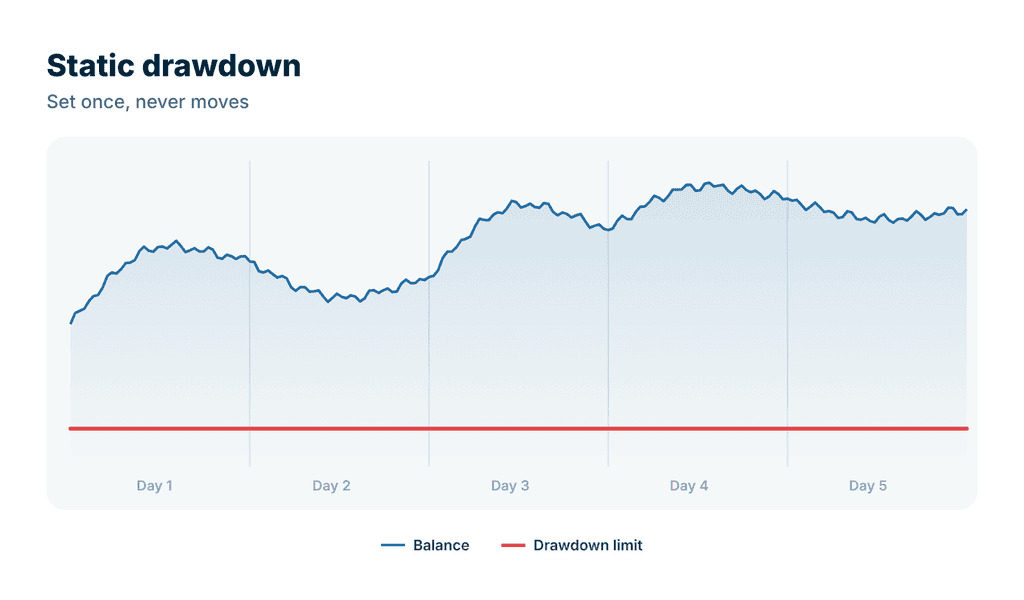
That doesn’t automatically make it better since the initial loss allowance, contract limits, daily loss rules, and other program conditions are still at play to determine how much risk you can take.
The static drawdown suits traders who prefer a clear, predictable risk limit that stays fixed regardless of how much their account balance grows. It can be particularly beneficial for traders who want to plan trades around a consistent risk threshold and fully focus on other applicable rules. It can also suit traders who want accumulated profits to widen their cushion, since the floor stays put as the account grows.
The daily loss limit: an equally crucial rule
A drawdown limit usually controls how far the account can fall against a defined threshold, while a daily loss limit (DLL) caps how much you can lose during a single trading day. The two rules can apply at the same time, and breaching either can end an evaluation, depending on the firm’s terms.
Imagine a trading evaluation with a $1,500 maximum drawdown and a $550 daily loss limit. Your account starts at $25,000* and you lose $250 in the morning. Later, another trade loses $200 and, as a result, you are down $450 for the day, leaving just $100 before you reach the daily limit. Even if the overall account balance remains comfortably above its drawdown floor ($1,050 of room, to be precise), another losing trade could breach the daily loss limit and end the attempt.
Each firm can have its own way of calculating daily losses (e.g., using realized losses, unrealized losses, commissions, etc.), so check the official rules rather than assuming the number works the same way everywhere.
A practical approach is to set your own daily stop below the firm’s limit. If the official limit is $550, for example, you might decide to stop trading after losing $350 and ensure a buffer for slippage, fast markets, or an unexpected position change. CME Group’s educational material on proper position sizing notes that position size should reflect where the stop is placed and how much you are prepared to risk.

The consistency rule: demonstrating sustainable performance
A consistency rule limits how much of your total profit can come from a single trading day or, in some programs, a single trade. The basic idea is to prevent a trader from reaching a target almost entirely through one unusually large result while producing little profit elsewhere. The consistency rule also aims to eliminate the role luck may play in one’s trading performance (e.g., a one-off big win).
For example, suppose an evaluation has a $3,000 profit target and a 50% consistency threshold. If you have reached the target and your best day earned $1,800, that day represents 60% of your total profit. Even though you have already hit the original target, you need to earn $600 more to meet the firm’s consistency requirement.
At Earn2Trade
At Earn2Trade, the evaluation consistency rule requires that no single trading day account for more than 30% of your total profit. Once you move to a funded trading account, there is no consistency rule.
Take the TCP25 track of the Trader Career Path®, for example. It has a $1,750 profit target, and 30% of it equals $525. That means that if you stop at the target, no single day can have contributed more than $525 toward the required profit. If you earn $600 on one day, you haven’t necessarily failed the evaluation, but you would need to bring your total profit to at least $2,000 for that day’s result to represent no more than 30% of the total.

Other rules that can end an evaluation
Drawdown and daily loss limits account for most failures according to Earn2Trade’s internal data, but they aren’t the only rules that can end an attempt.
Contract limits, for example, restrict how many futures contracts you may hold for the particular account tier. Some firms’ programs increase the permitted position size as the account balance grows or reaches specified milestones.
Trading-hour restrictions determine when you can open or hold positions. Some programs require traders to close positions before a market break or at a specified cutoff. Leaving an open position beyond the allowed time can become a rule violation, even if it is profitable.
Depending on the firm, an evaluation or funded trading account may have minimum activity requirements or rules concerning how long an account can remain unused.
Why most traders fail: Insights from Earn2Trade internal data
At Earn2Trade, 8.89% of new subscriptions resulted in a passed evaluation in 2025 (Earn2Trade Exam Disclaimer).
15,000+ failed accounts: 56% due to drawdown limit, 34% due to daily loss limit (Earn2Trade internal data).
Earn2Trade internal data across 15,000+ failed accounts shows that 90% of failures resulted from breaching two specific risk limits: 56.3% were tied to the drawdown limit and 34.3% to the daily loss limit. Another 2.3% failed because they traded outside approved hours. About 39% of failures were repeat attempts.
In a nutshell, the rules that most often end an attempt are the limits that govern how much an account can lose overall and how much it can lose in a single day. So, even with a workable strategy, a trader can still fail by trading too large, continuing after a bad start, or not adjusting risk after a strong session.
The 39% of failures coming from repeat attempts also deserve attention, as they highlight the importance of reviewing the process after a failed evaluation rather than simply buying another attempt and trading the same way. If the cause was excessive position size or a tendency to chase losses, a new evaluation fee won’t fix it.
How to trade within the rules
The most important thing to help you avoid violating rules and risking your account is not making the loss threshold the deciding factor in every trade.
Start with position sizing. Before entering a trade, identify where the trade idea is invalidated and estimate the loss if the stop is hit. Then decide whether that loss is reasonable relative to the remaining drawdown room. If the position would consume a large share of your available buffer, reduce its size or skip the trade. CME Group’s risk-management guidance explains why a losing streak can erode an account faster than traders expect and why preset risk limits matter.
Next, use a personal stop below the firm’s daily loss limit. Don’t plan to stop exactly at the official limit since trading costs, slippage, and changing unrealized profit or loss can make the final outcome different from the number you had in mind. Once you reach your personal stop, end the session rather than trying to win back the loss.
Finally, be especially careful after a large winning day if your program uses a trailing intraday drawdown. A new high may move the loss floor upward, reducing the amount you can give back before breaching it. Consider lowering your position size or setting a tighter personal stop on the next session. A good day isn’t a reason to increase risk automatically.
How drawdown works at Earn2Trade
At Earn2Trade, the drawdown method depends on the stage and program, and the rules aren’t identical across every account. For example, evaluation and LiveSim® funded trading accounts use EOD drawdown where the floor adjusts upward based on positive account performance at the end of the day. Open equity losses are still considered when determining whether the minimum balance has been breached.
Live funded trading accounts, by contrast, use a trailing drawdown. The floor rises dollar for dollar with positive account performance during the trading day until it reaches the starting balance, then stops rising.
For example, the TCP25 track of the Trader Career Path® has a $1,500 EOD drawdown, a $550 daily loss limit, and a 2-contract limit (at Earn2Trade, the platform automatically enforces contract limits, so an order that would exceed the limit is blocked rather than causing a failure). The top tier of the Trader Career Path® ($200,000* for TCP25 and $400,000* for TCP50 and TCP100), on the other hand, uses a fixed drawdown ($194,000* and $388,000*, respectively), meaning the minimum balance is set from the beginning and doesn’t trail upward.

For the exact definitions and program-specific drawdown details, see the Earn2Trade Help Center’s dedicated guide.
The Trader Career Path® and Gauntlet Mini™ pages provide information on the rest of the risk rules and program requirements, such as contract limits, consistency rules, daily loss limits, and approved trading times (no overnight positions; all orders must be closed by 3:50 PM CT, and no trading is allowed until 5 PM CT; earlier cutoffs apply to some assets).
Frequently asked questions
It depends on the firm’s rules. Some trailing drawdowns stop moving once the floor reaches the starting balance, while others may use a different threshold or calculation. Confirm the point at which it stops, if any, before trading. At Earn2Trade, the trailing drawdown stops moving once it reaches the starting account balance.
Illustrative example – not actual trading data: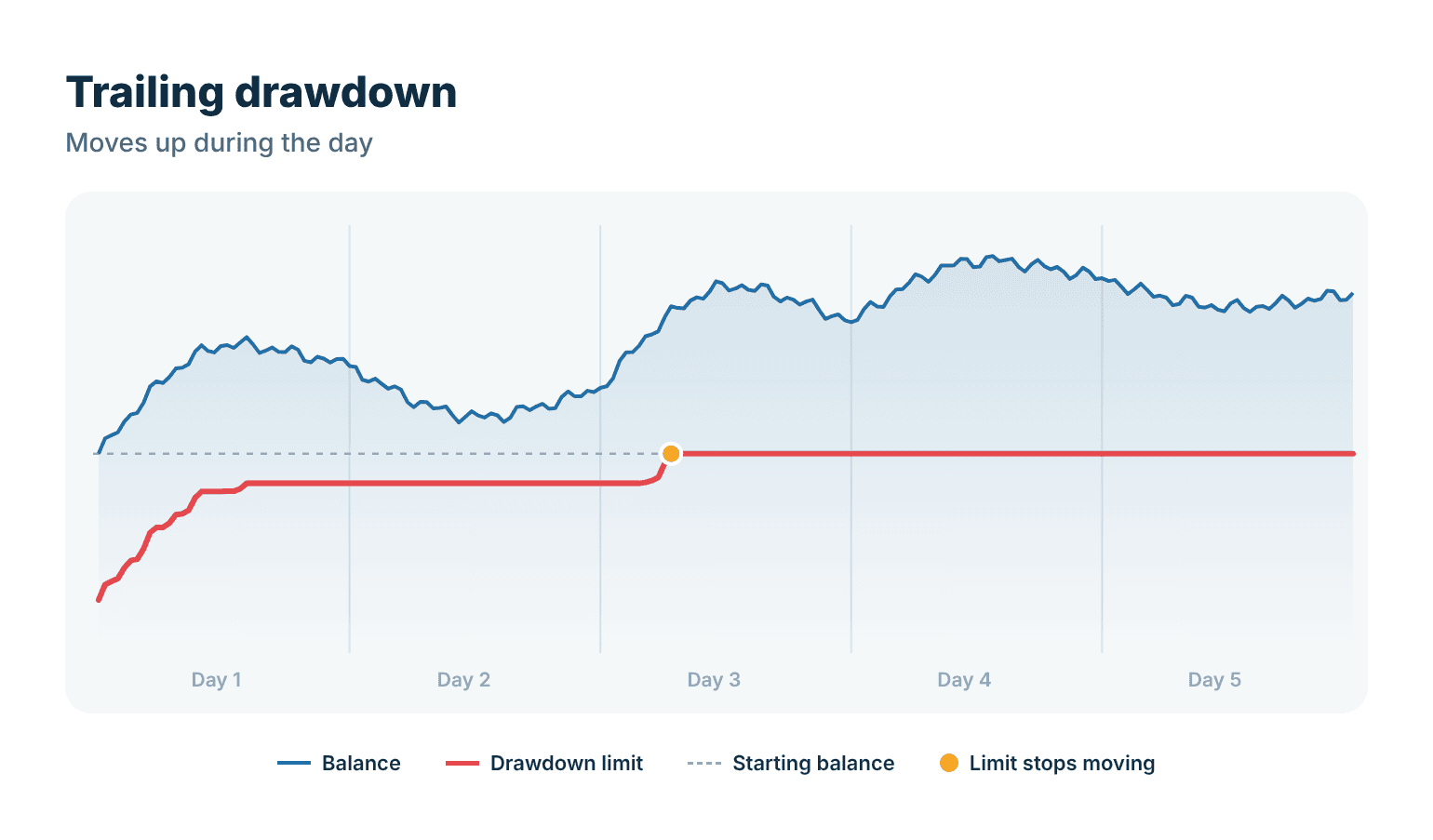
An intraday trailing drawdown moves in real time as the account reaches new highs during the session. An end-of-day trailing drawdown updates based on the closing balance. That can give traders different amounts of room during an active session. Whether unrealized gains and losses factor into the drawdown calculation depends on the program. At Earn2Trade, open equity is considered, so unrealized losses count toward a breach.
Illustrative example – not actual trading data: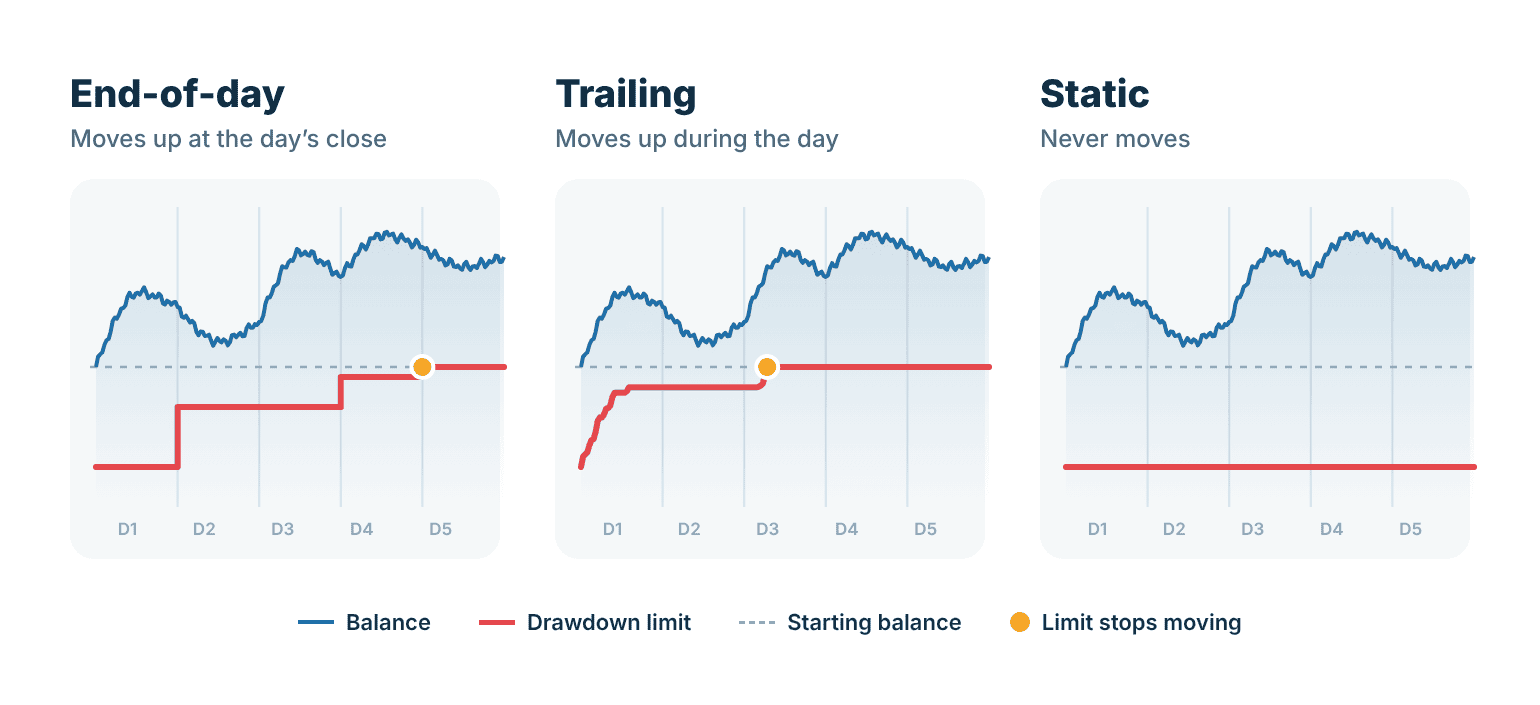
Yes. Many programs define the daily loss limit for each trading session, but reset times vary, so confirm the firm’s session boundary. Also, check whether it is based on realized losses, unrealized losses, commissions, or a combination. At Earn2Trade, the daily loss limit follows the CME trading day and is calculated on open equity in real time.
A breach typically ends the evaluation or triggers the consequences specified for the particular funded trading account. Don’t assume you can recover the balance by placing another trade. Check the firm’s liquidation and account-termination rules before trading.
Neither is universally better. Static drawdown keeps the floor fixed, while trailing drawdown can raise it as the account makes new highs. Which one suits your case depends on the strategy, the size of the loss allowance, and the other rules attached to the program.
No. Firms differ on whether they use a consistency rule, when it applies, and how they calculate it. Some apply it during evaluation, some apply additional conditions at the funded stage, and others don’t use one at all. Read the rules for the specific program rather than assuming that one firm’s policy applies across the industry.
The takeaway: Drawdown rules are easier to respect when you know exactly how they are calculated, how much room remains, and what other limits apply at the same time. Before trading, check the drawdown method, daily loss limit, consistency rule, and trading-hour restrictions. Then size positions against the available risk room.
*At Earn2Trade, evaluation and LiveSim® account balances are virtual; Live accounts use real capital.