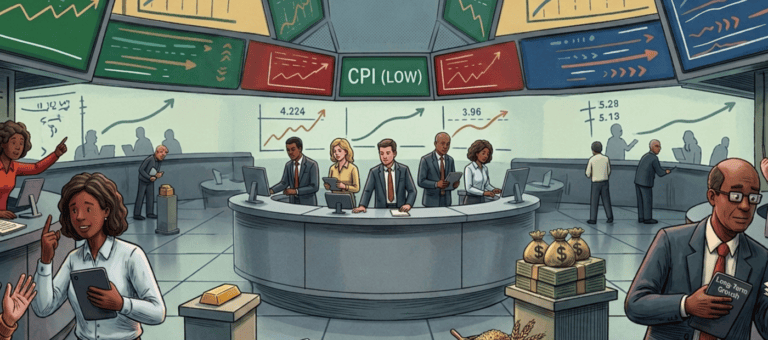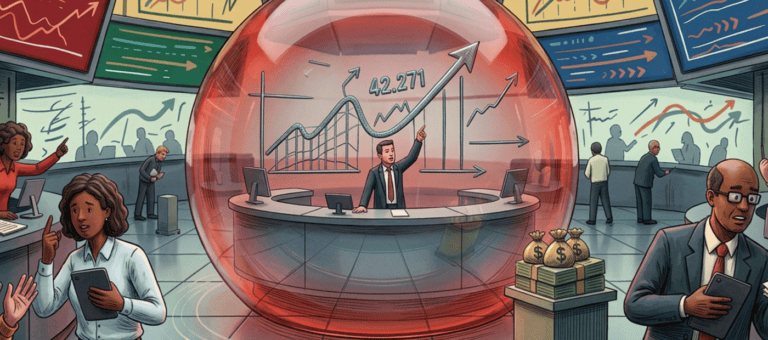
A tariff announcement can look deceptively simple on paper – e.g., as of July 2026, the U.S. trade-weighted tariff rate had reached 10.5% according to data from the WTO–IMF Tariff Tracker, which is a significant rate in recent economic history. What’s important is not the number itself, but the context behind it and the moves of different parties. For example, one government raises duties on imported goods, another threatens retaliation, economists revise growth forecasts, and politicians argue over who will bear the cost. Yet by the time the announcement reaches a funded futures trader’s screen, it has already become something much larger than a trade-policy story.
For example, the S&P 500 may be repricing weaker corporate earnings, treasury futures may be reacting to a new inflation outlook, or crude oil can fall on fears that slower global trade will reduce energy demand. Also, gold may rise as investors seek protection from political and economic uncertainty, and the U.S. dollar can strengthen or weaken depending on whether traders focus on inflation, growth, capital flows, or the credibility of American assets.
For a trader in a funded program, this matters because tariff regimes tend to change the market environment without altering the trading rules. Your daily loss limit remains the same, and your trailing drawdown doesn’t become more forgiving because Washington, Beijing, Brussels, or another major capital announced a new round of duties overnight. Yet the character of the market can change dramatically, and a position size that felt conservative during a quiet week may suddenly become dangerously large when trade headlines begin producing 1% intraday swings in equity futures.
This guide explores everything you need to know about tariffs – not merely as a macroeconomic matter, but as a source of volatility, sector rotation, inflation surprises, currency adjustments, and abrupt changes in expectations to help you understand the transmission mechanism between tariffs and markets and how it might affect your performance.
What Are Tariffs and How Do They Work?
A tariff raises the cost of imported goods – e.g., if a U.S. company imports steel, electronics, machinery, vehicles, or components subject to a higher duty, somebody in the supply chain eventually has to absorb that additional cost. The importer may accept lower margins, while the supplier may cut prices and the consumer may pay more. In practice, the burden can be distributed among several parties.
However, for traders, the interesting part begins after that. Higher import costs can feed into inflation, while retaliation from trading partners can weaken export demand. Businesses facing uncertainty may delay investment, and supply chains can be reorganized, sometimes at considerable expense. Central banks might then have to assess an uncomfortable combination where prices may rise even as growth slows.
That often creates a market problem with no single obvious answer – take the Federal Reserve, for example. If tariffs contribute to higher prices, the inflation side of the equation could argue for tighter monetary policy or fewer interest-rate cuts. If tariffs simultaneously damage growth and employment, the opposite argument emerges. Treasury futures can therefore react not simply to the tariff itself, but to the market’s changing view of which consequence will matter more.
This is why two tariff announcements of apparently similar size can produce very different market reactions. Note that the details matter significantly and you should always ask questions to get the context right.
For example, is the tariff targeted at one sector or applied broadly? Is it expected, or does it represent a major surprise? Will trading partners retaliate? Is the economy already slowing? Are inflation expectations stable? Is the announcement immediately enforceable, or is it mainly a negotiating tactic?
Let’s dive further.
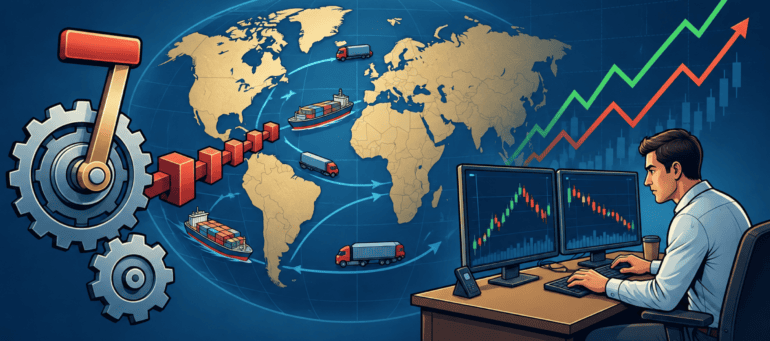
Why Futures Traders Should Care About Tariff Regimes: The Impact on Different Instruments
If a long-term investor owns a diversified portfolio with a 20-year horizon, a bad tariff headline may simply become another unpleasant week in an otherwise long investment journey. However, a funded futures trader has no such luxury.
Futures markets compress macroeconomic expectations into highly leveraged, rapidly repriced instruments where a shift in the outlook for growth, inflation, interest rates, or international demand can quickly affect contracts tied to equities, bonds, currencies, metals, energy, and agriculture.
The most obvious exposure is found in equity index futures. The E-mini S&P 500 and Nasdaq-100 futures can react immediately when tariffs threaten corporate earnings, disrupt supply chains, or raise concerns about economic growth. The impact is rarely distributed evenly – e.g., companies with heavy import exposure may face higher costs, while exporters may be vulnerable to retaliation. Furthermore, technology stocks can become particularly sensitive when trade restrictions involve semiconductors, electronics, or other strategically important components.
But the impact of tariffs extends way beyond the equity market. For example, with treasury futures, if tariffs raise expected inflation, bond prices can fall, and yields can rise. Furthermore, if the same tariffs create sufficient uncertainty to weaken growth, investors may begin to expect future rate cuts, thereby supporting bond prices.
Currency futures add another layer. A tariff regime can alter trade flows, expected interest rates, and capital movements. For example, a country whose economy appears relatively insulated may see its currency strengthen, while one that is heavily dependent on exports may experience the opposite. Yet the relationship isn’t mechanical, as evidenced by the April 2025 market reaction, which demonstrated that even the U.S. dollar can weaken during a period when many traders might initially assume tariffs would support it.
Commodity markets can be even more nuanced. Take crude oil, for example – oil traders care deeply about global economic activity because transportation, manufacturing, and industrial production all influence demand. When a major tariff escalation raises the prospect of weaker global growth, crude can fall even if there has been no change in physical supply. For example, on April 3, 2025, after the announcement of broad U.S. tariffs, Brent and WTI futures both declined by more than 2% as traders focused on the potential for weaker global demand. Four days later, after China announced additional tariffs on U.S. imports, Brent and WTI were each down by more than 3% in the reported session.
So, in those cases, the market was effectively asking a forward-looking question: if trade barriers slow the world’s two largest economies and disrupt global commerce, what happens to future oil consumption?
That same logic can affect copper, soybeans, corn, natural gas, and other commodity markets, although each contract has its own supply-and-demand structure. Agriculture is especially exposed to retaliation because tariffs can redirect purchasing decisions almost immediately. Industrial metals can react to anticipated changes in manufacturing activity and construction. Gold, meanwhile, may benefit when the trade dispute becomes part of a broader risk-off environment.
All of the above explain why a tariff story should be treated as a macro catalyst rather than a single-market signal.
How a Tariff Announcement Affects Markets in Practice
A useful way to think about tariffs is to picture a row of dominoes, with the first domino being the policy announcement, while the last may be a move in the futures contract you trade. Between them are several layers of interpretation.
| Stage | What Changes | Futures Markets Most Likely to React |
| Tariff announcement | Immediate policy surprise and uncertainty | Equity index and currency futures |
| Corporate cost repricing | Margin and earnings expectations change | S&P 500 and Nasdaq futures |
| Inflation reassessment | Import costs may affect consumer prices | Treasury and interest-rate futures |
| Growth concerns | Trade volumes and investment expectations weaken | Equity indices, crude oil, copper |
| Retaliation | Exporters and specific industries face new risks | Agricultural, industrial and equity futures |
| Central-bank repricing | Markets revise expectations for future rates | Treasury, SOFR and currency futures |
| Risk sentiment | Investors adjust exposure to uncertainty | Equity indices, gold, currencies |
The important word in that table is “may,” since traders often get into trouble when they treat an economic relationship as certain.
The thing is that you will often hear advice such as: “Higher tariffs mean inflation, so short bonds,” “Trade wars weaken the dollar,” or “Tariffs are bad for stocks, so short the S&P.” While these might sound reasonable, they might work until the market sentiment changes (e.g., participants decide that the measures are temporary, negotiable, or already priced in). The truth is that markets trade expectations, not classroom diagrams.
The practical implication for funded traders and participants in funded trading programs like Earn2Trade’s Trader Career Path® and The Gauntlet Mini™ is to avoid building a trade on the assumption that tariffs are generally good or bad for a particular asset. Instead, they should be built around the market’s reaction to new information.
The Inflation Problem: Why Tariffs Can Make the Trading Environment More Complicated
Tariffs have long been associated with higher prices, but the market consequences depend on timing and pass-through. Take importers, for example. They don’t always raise prices immediately, with some absorbing the cost through margins, using existing inventories, renegotiating with suppliers, or redirecting sourcing. The result is often a lag between the policy announcement and its visible effect on inflation data.
That lag matters enormously for traders. A tariff announcement can prompt an immediate move in the S&P or Nasdaq, while the more durable inflation effects may only begin to appear months later, and traders who assume the story is over after the initial reaction may miss the second phase.
In reality, the initial headline may trigger a risk-off move, and several months later, higher goods prices may complicate the Federal Reserve’s inflation outlook. Treasury futures, equity indices, and the dollar may then begin responding to a different version of the same story. For the trader, this means that tariff analysis shouldn’t end with the announcement date.
Instead, it is important to watch what happens to:
- inflation expectations;
- producer and consumer price data;
- corporate guidance;
- Treasury yields;
- Federal Reserve communication;
- commodity demand expectations.
At the end of the day, the tariff itself is the stone thrown into the water, while the market often trades the ripples.
Strategies for Trading During the Post-Tariff Period
The most effective tariff strategy is to design a process for recognizing when the environment has changed. Here are a few steps on how to do it:
- Reduce the importance of being first: Major policy news often triggers an initial move dominated by algorithmic activity, positioning adjustments, and thin liquidity. So, in that sense, letting the first few minutes pass doesn’t mean surrendering the opportunity.
- Define your maximum event risk before entering: If you normally risk $200 per trade, don’t wait until after the announcement to realize that volatility requires a $500 stop – either reduce size enough to preserve your predetermined dollar risk or skip the setup.
- Separate the news trade from the trend trade: A tariff headline may cause an immediate reversal without changing the broader daily trend. Conversely, it may become the catalyst that finally breaks a multi-week range.
- Keep a record of market expectations before major announcements: Write down what you believe the market is pricing in. After the news, compare your assumption with the actual reaction. This will prevent the hindsight bias from rewriting the story after the outcome is known.
- Don’t average down because your macro thesis still sounds convincing: A policy narrative can be correct in the long run and still destroy an intraday position. Don’t forget that funded trading is governed by account-level risk, not by how persuasive your economic argument appears.
- Finally, know when the trade regime has ended: Markets eventually move on. A tariff announcement that dominates headlines for two days may become irrelevant once an inflation report, a central bank meeting, or a geopolitical event takes over. Traders who continue fighting the previous week’s battle often become anchored to an outdated narrative.
Aside from the steps above, it is also important to follow particular principles to keep you grounded, such as:
Learn to Separate Headlines from the Trade
A tariff announcement can produce an almost irresistible urge to act. The headline appears, futures move sharply, social media fills with explanations, and within minutes there seems to be a consensus about what the market “should” do.
However, the trader’s first job isn’t to predict the ultimate economic consequences of the policy but to understand what the market is doing with the information at hand.
For example, consider three possible reactions to the same bearish tariff headline.
In the first, ES drops immediately, breaks an important overnight low, fails to recover it, and selling spreads into Nasdaq and other risk-sensitive markets. That suggests the news has altered positioning in a meaningful way.
In the second, ES sells off for several minutes, finds buyers at a previously established support zone, and recovers the entire move. The headline may have been expected, or the market may believe the policy will eventually be softened.
In the third, the initial move is violently bearish, followed by a sharp reversal, another selloff, and then a second reversal. This is often the most dangerous environment for a funded trader because the market is still trying to determine what the news means.
The temptation is to interpret every movement as information, but more often than not, the correct conclusion is simpler – there isn’t yet enough clarity to justify a trade. At the end of the day, you won’t receive a prize for having an opinion before everyone else, and your account will record only the results of your trading decisions.
Build a Tariff Calendar, Not Just an Economic Calendar
Most futures traders already know to monitor major scheduled releases: CPI, PPI, employment data, GDP, Federal Reserve decisions, and major inventory reports. However, in the current trade environment, that calendar is incomplete without a policy layer.
A tariff calendar doesn’t need to predict politics, but instead has to identify periods when markets may be unusually sensitive to trade developments. So, in that sense, it is important to keep track of:
- announced implementation dates for new duties;
- deadlines for temporary tariff suspensions;
- major bilateral negotiations;
- scheduled trade reviews;
- court decisions affecting existing tariff authority;
- expected retaliatory measures;
- major speeches from policymakers directly involved in trade policy;
- WTO and other international developments where relevant to the markets you trade.
This doesn’t mean staring at news feeds all day, of course. In fact, that can create another problem: information overload. The goal here is simply to know when an apparently quiet trading session coincides with a major policy deadline.
A Practical Tariff-Regime Playbook for Funded Traders and Participants in Funded Trading Programs
Before we dive into the practical scenarios, let’s just make one thing clear – when it comes to trading during periods of turbulent tariff policy decisions, doing nothing is a legitimate trading decision. This sounds obvious until a trader is halfway through an evaluation and feels pressure to make progress. Profit targets can distort behavior because they encourage participants to view every volatile session as an opportunity that must be captured. In reality, some of the best risk management occurs when a trader recognises that the probability of execution quality has declined.
However, note that during periods of volatile tariff policy decisions, things can get pretty challenging, especially for beginners, so you should prioritise capital preservation first and growth second.
| Market Situation | What to Watch | Practical Response |
| Tariff announcement is broadly expected | Whether price had already moved before the news | Avoid chasing the first reaction; focus on whether key levels hold or fail |
| Tariff is larger or broader than expected | Equity futures, Treasury yields, dollar and commodity confirmation | Reduce size and allow the first volatility burst to develop |
| Retaliation is announced | Products and sectors directly exposed | Look for contract-specific effects rather than trading only the broad index |
| Markets begin pricing higher inflation | Treasury yields, rate expectations, inflation data | Avoid assuming bonds will automatically rally on growth concerns |
| Growth fears dominate | ES/NQ, crude oil, copper and other cyclical assets | Monitor cross-market confirmation, but avoid stacking correlated positions |
| Negotiations improve, or tariffs are delayed | Whether the market was positioned for escalation | Watch for sharp reversals and short-covering rather than assuming the prior trend will continue |
| The story becomes unclear | Whipsaw price action and conflicting cross-market signals | Trade smaller – or do nothing |
To Wrap Up: Trading the Tariff Headlines Requires Adaptation
Global tariff regimes matter because they change the environment in which futures contracts trade. They can affect corporate earnings, consumer prices, global growth, commodity demand, currency flows, and central-bank expectations. More importantly, they can change the relationships between those variables.
That last point is what makes them difficult. A tariff escalation can initially look like an inflation story, then become a growth story. A growth scare can push investors toward Treasuries unless inflation concerns dominate, while a weaker outlook can hurt crude oil unless a supply disruption simultaneously reduces available barrels. The same policy may create winners and losers within an equity index, producing an outcome that is less obvious than the headline suggests.
So, for a funded trader or a participant in funded trading programs like Earn2Trade’s Trader Career Path® and The Gauntlet Mini™, there is no need to predict every twist in that chain. Instead, focus on recognizing when trade policy is changing volatility and correlations, understanding which markets are most exposed, and adjusting risk before the market forces you to.
Treat tariff regimes as a map of evolving risks rather than a collection of buy-and-sell signals. Try to learn where the pressure points are, watch how markets react rather than relying solely on what economics textbooks say they should, and respect correlations. Be proactive and reduce size when volatility expands, and remember that protecting a funded account during an unstable policy regime is your sole goal.
Last but not least, note that sometimes the best trade is the one you took with a smaller size, while at other times it is the position you closed before the headline hit. And when the tariff map becomes too complicated to read, it might be the trade you never placed at all.